
Why security matters in trading: protect your capital
TL;DR:
- Hackers targeted large crypto exchanges and well-funded trading platforms through sophisticated exploits.
- Personal security measures like enabling 2FA and using unique passwords are crucial for traders.
- Regulation protects funds from broker failure but doesn’t prevent personal account breaches.
In early 2025, hackers linked to North Korea stole $1.5 billion in Ethereum from Bybit, one of the world’s largest crypto exchanges, through a sophisticated wallet exploit. Separately, XTB clients lost $38,000 when attackers bypassed withdrawal controls using rapid automated trades. These weren’t small, obscure platforms. They were established, well-funded operations with dedicated security teams. If incidents like these can happen at that scale, every retail and professional trader needs to take a hard look at their own exposure. This guide breaks down the real threats, how regulation helps and where it falls short, and the specific steps you can take right now to protect your capital.
Table of Contents
- The real risks: Threats traders face every day
- How regulations help (and where they fall short)
- Essential security measures for every trader
- What both retail and pro traders get wrong about security
- A smarter approach: Redefining responsibility in trading security
- Next steps: Trade smarter and safer with Olla Trade
- Frequently asked questions
Key Takeaways
| Point | Details |
|---|---|
| Trading is a prime cybercrime target | High-value accounts and around-the-clock markets make Forex, CFD, and crypto trading especially attractive to hackers. |
| Regulation helps, but isn’t enough | Regulated brokers must follow strict security rules, but user vigilance and good practices are still essential. |
| Simple steps prevent most losses | 2FA, strong passwords, withdrawal whitelists, and cold storage stop many attacks cold—when used consistently. |
| Shared responsibility is critical | Both traders and platforms must act to keep investments and data safe; neglect on either side increases risk. |
The real risks: Threats traders face every day
Trading accounts are uniquely attractive targets. You’re moving real money, often in real time, across platforms that operate 24 hours a day, seven days a week. That constant availability is exactly what attackers exploit. Unlike a bank that closes at 5 PM, a compromised trading account can be drained at 3 AM on a Sunday before you even notice.
Financial firms face 300 times more cyberattacks than businesses in other sectors, and trading platforms sit at the center of that target. Remote Desktop Protocol (RDP) vulnerabilities appear in 90% of financial cyberattack incidents, giving attackers a direct path into systems when security configurations are weak. The Bybit breach and the XTB rapid-trade hack show that even enterprise-grade infrastructure can fail when a single exploit goes undetected.
Here are the four most significant trading security threats you face as a trader:
- Phishing and social engineering: Fake emails, spoofed broker websites, and fraudulent support calls trick traders into handing over login credentials or approving malicious transactions.
- Malware and keyloggers: Software installed through infected downloads or links silently records your keystrokes, capturing passwords and two-factor authentication (2FA) codes in real time.
- Credential stuffing: Attackers use leaked username and password combinations from unrelated data breaches to try logging into trading accounts, betting that you reused the same credentials.
- Direct broker exploits: Vulnerabilities in broker infrastructure, APIs, or third-party wallet integrations allow attackers to bypass normal security controls entirely, as seen in the Bybit case.
“High-value accounts and around-the-clock market access make Forex, CFD, and crypto trading platforms prime targets for cybercriminals. The main forex trading risks are no longer just market-related. They’re increasingly digital.”
The financial stakes make every account worth attacking, regardless of its size. A $5,000 retail account is still $5,000. Attackers use automated tools to test thousands of accounts simultaneously, so no one is too small to be a target.
How regulations help (and where they fall short)
Regulation is the first institutional layer of protection between you and a catastrophic loss. When you trade with a regulated broker, your funds are legally required to be held in segregated client accounts, meaning they’re kept completely separate from the broker’s own operating capital. If the broker goes bankrupt, your money isn’t swept up in the insolvency.
The UK’s Financial Services Compensation Scheme (FSCS) covers up to £85,000 per eligible claimant if a regulated firm fails. Australia’s ASIC enforces similar segregation requirements, while CySEC in the EU operates under MiFID II rules that mandate negative balance protection and fund separation. These are meaningful protections, especially for retail traders.
Here’s a direct comparison of what you get with regulated versus unregulated brokers:
| Feature | Regulated broker | Unregulated broker |
|---|---|---|
| Segregated client funds | Yes, legally required | No guarantee |
| Compensation scheme | Yes (e.g., FSCS up to £85,000) | None |
| Dispute resolution | Formal process available | No recourse |
| Negative balance protection | Required in many jurisdictions | Varies or absent |
| Regulatory oversight | Regular audits and reporting | None |
When choosing a broker, look for these five things:
- Active license from a recognized authority (FCA, ASIC, CySEC, or equivalent)
- Clear disclosure of fund segregation practices
- Published compensation scheme membership
- Transparent fee structure with no hidden withdrawal conditions
- Verifiable track record and accessible regulation and trading protection documentation
“Regulation creates a safety net, but it was never designed to protect against every threat. It covers broker failure and certain forms of misconduct. It does not cover your account being accessed by a third party because you clicked a phishing link.”
That’s the critical gap. Understanding how CFDs work and choosing a regulated broker is essential, but it only protects you from institutional failures. Your personal account security is entirely your own responsibility.
Essential security measures for every trader
Regulation is an important backstop, but protecting your investments also means taking ownership of your personal security setup. The good news is that the most effective measures are straightforward to implement.
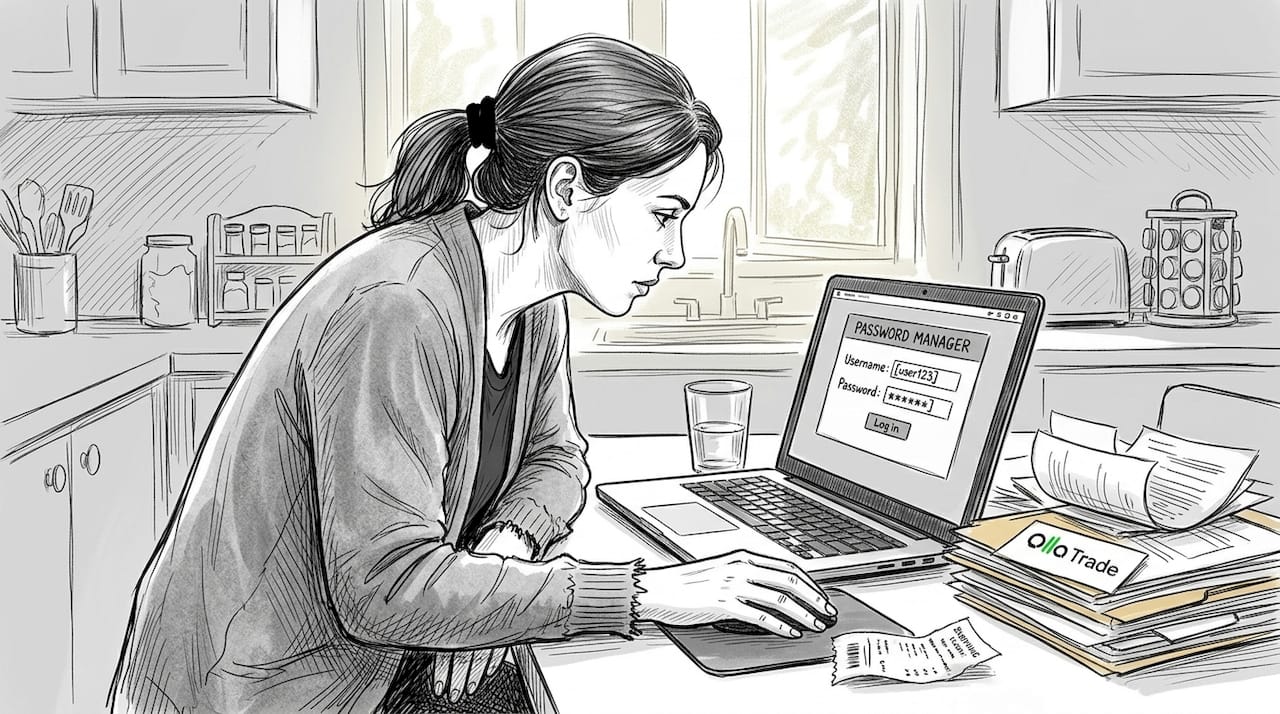
Two-factor authentication (2FA) is the single most impactful step you can take. App-based 2FA (like Google Authenticator or Authy) is significantly more secure than SMS-based codes, which can be intercepted through SIM-swapping attacks. Hardware security keys are even stronger. Enable 2FA on every platform you use.
Here’s how core security measures stack up against specific attack types:
| Security measure | Phishing | Credential stuffing | Malware | Broker exploit |
|---|---|---|---|---|
| App-based 2FA | Partial | Yes | Partial | No |
| Unique strong passwords | No | Yes | No | No |
| Whitelisted withdrawal IPs | Yes | Yes | Yes | Partial |
| Cold storage (crypto) | N/A | N/A | Yes | Yes |
| Multi-signature wallets | N/A | N/A | Yes | Yes |
| VPN on public networks | Yes | Partial | Yes | No |
For crypto holdings specifically, top hardware wallets keep your private keys completely offline. The industry standard is to store 95% or more of crypto funds in cold storage, with only a small operational amount kept in hot wallets for active trading.
Steps to secure your trading account right now:
- Enable app-based or hardware 2FA on all trading and email accounts
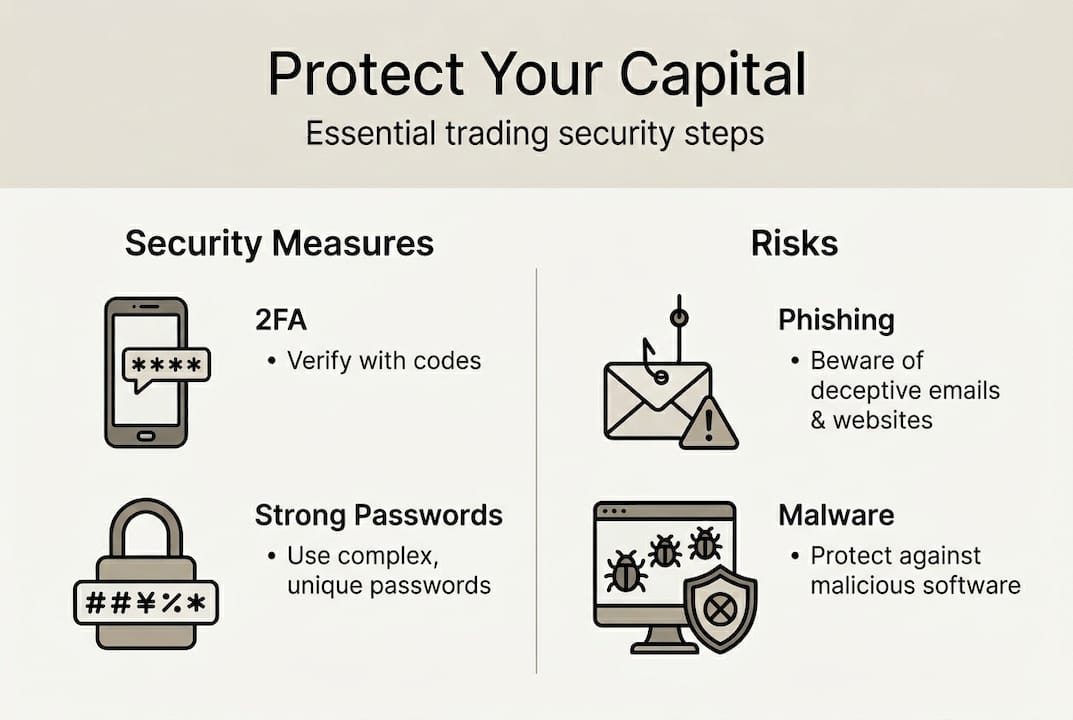
- Create a unique, randomly generated password for each platform (use a password manager)
- Whitelist your IP address and approved withdrawal destinations in your broker’s settings
- Avoid logging in on public WiFi; use a reputable VPN when traveling
- Move long-term crypto holdings to cold storage immediately
Pro Tip: The most common reason traders get hacked isn’t sophisticated malware. It’s skipped basics. Enabling 2FA takes three minutes and blocks the majority of automated account takeover attempts. Review your trading best practices and make sure these steps are actually active, not just planned.
Your trading security tools and platform security setup should be reviewed every quarter, not just when you open a new account.
What both retail and pro traders get wrong about security
You might assume robust security is automatic if you’re with a reputable broker or a prop firm, but case studies tell a different story. The mistakes are different at each level, but they’re equally costly.
Retail traders most commonly underestimate their exposure. They assume their account balance is too small to attract attention, reuse passwords across multiple platforms, skip 2FA because it feels inconvenient, and click on phishing emails that convincingly mimic their broker’s branding. The XTB incident is a clear example: phishing and social engineering remain the top entry points, even for accounts with legitimate broker protection.
Professional traders make a different mistake. They trust institutional security too much. They assume that because their firm has compliance teams, encrypted systems, and insurance policies, their personal security habits don’t matter as much. But even regulated brokers can be compromised when individual users skip personal 2FA or use weak credentials on their own devices.
Prop firms have added AI-powered fraud detection to catch unusual trading patterns and flag suspicious withdrawals. That’s a meaningful layer of protection. But it doesn’t stop an attacker who has already authenticated with your stolen credentials.
The four most common mistakes, across both groups:
- Reusing passwords from other platforms that have already been breached
- Skipping 2FA on email accounts linked to trading platforms
- Trusting unsolicited messages or calls claiming to be from broker support
- Assuming institutional security replaces the need for personal vigilance
“Regulators increasingly view account security as a shared responsibility. Platforms must provide the tools; traders must use them. Failing to enable available protections may limit your ability to recover losses from crypto risk incidents.”
Pro Tip: Think of your broker’s security infrastructure as a vault door. It’s strong, but only you hold the key. If you hand that key to a phisher, no vault door in the world will protect what’s inside.
A smarter approach: Redefining responsibility in trading security
Here’s something the industry rarely says out loud: most major breaches aren’t caused by a lack of technology. They happen because of a failure in shared responsibility. The old mental model, where traders assume their broker handles everything, is genuinely dangerous in 2026.
We’ve seen this pattern repeatedly. A platform invests millions in infrastructure security. A trader skips 2FA. The account gets drained. The broker’s security worked exactly as designed. The trader’s didn’t.
The smarter mindset treats security as a two-sided partnership. Regulators and platforms are moving in this direction, increasingly requiring users to take active steps rather than passively relying on institutional safeguards. Building trading confidence starts with understanding that your habits are part of the security architecture, not separate from it.
The next generation of trading platforms will reward active security habits with tangible benefits: faster withdrawals, higher limits, and better access to advanced tools. Traders who treat security as a personal discipline rather than someone else’s problem will have a measurable edge, both in protecting capital and in accessing the best platforms.
Next steps: Trade smarter and safer with Olla Trade
Ready to put better security practices to work? Here are your next steps.
Olla Trade provides traders with the resources and tools to make informed, secure decisions across secure Forex trading, CFDs, and crypto markets. Whether you’re just getting started or refining a professional setup, the platform’s educational content covers the mechanics of about CFDs, risk management frameworks, and the security fundamentals that protect your capital.
Explore the secure trading guide to see exactly how Olla Trade’s tools and account features support a safer trading environment. From platform setup to market research, every resource is designed to help you trade with both skill and confidence. Your capital deserves that level of care.
Frequently asked questions
What are the biggest security threats in trading today?
Phishing, hacks, and account takeovers are the most common threats, typically delivered through social engineering or malware targeting trader credentials and session data.
Does trading with a regulated broker fully protect my funds?
Regulated brokers must segregate client funds and offer compensation schemes, but these protections do not cover personal account breaches caused by compromised credentials or phishing.
What basic steps should I take to secure my trading account?
Enable app-based 2FA, use a unique strong password for every platform, and whitelist your approved withdrawal addresses and IP addresses immediately.
Why do so many traders still get hacked, even with security tools available?
Most successful attacks exploit skipped basics like 2FA or phishing clicks, proving that security tools only protect you when you actually use them consistently.
Recommended
아티클은 정보 제공 및 교육 목적으로만 제공되며 투자 조언에 해당하지 않습니다. CFD 거래에는 상당한 손실 위험이 따릅니다. 과거 실적은 미래 결과에 대한 신뢰할 수 있는 지표가 아닙니다. Olla Trade Ltd.는 앵귈라에 등록된 법인입니다.