
How Much Money Can You Make Trading Forex in 2026?

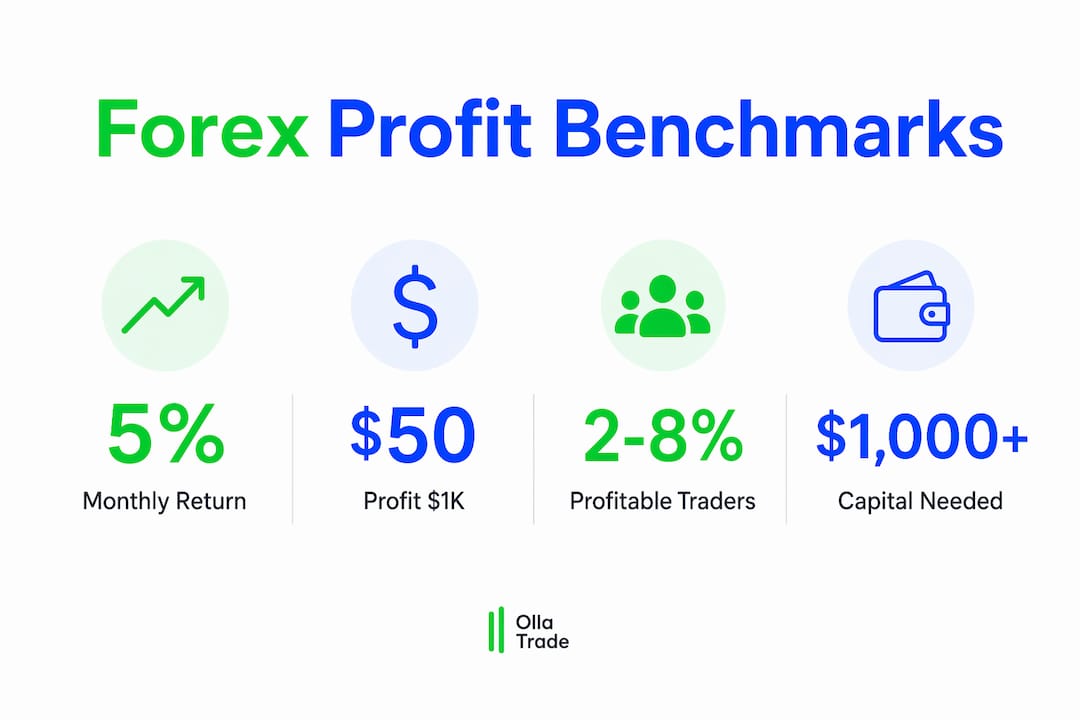
Forex trading income potential is real, but it is almost entirely a function of three variables: your capital, your monthly return rate, and your consistency. A skilled trader earning 5% monthly makes $50 on a $1,000 account, $250 on a $5,000 account, $500 on a $10,000 account, and $2,500 on a $50,000 account. The skill is identical across all account sizes—the capital is not.
Here is what realistic earnings look like by account size, assuming a consistent 5% monthly return:
- $1,000 account: ~$50/month. Useful for skill development, not income replacement.
- $10,000 account: ~$500/month. Meaningful supplemental income once you are consistently profitable.
- $50,000 account: ~$2,500/month. Viable secondary income or emerging primary income.
- $100,000 account: meaningful full-time income territory for disciplined traders.
Only 10–25% of retail forex traders are profitable in any given month, and the profitable minority averages 2–8% monthly returns. The $10,000/month promises on social media require either enormous capital or reckless risk. Neither is a plan.

How much can you make trading forex with different account sizes?
The math behind forex profits is straightforward once you stop thinking in dollar targets and start thinking in percentages. Professional traders think in percentages first. The dollar figure is a byproduct of applying your edge to your capital base.
| Account Size | Monthly Return | Estimated Monthly Profit | Realistic Goal |
|---|---|---|---|
| $1,000 | 5% | $50 | Skill development |
| $5,000 | 5% | $250 | Supplemental income |
| $10,000 | 5% | $500 | Part-time income |
| $25,000 | 5% | $2,500 | Solid secondary income |
| $50,000 | 5% | $2,500 | Full-time potential |
A day trader on a $25,000 account risking 1% per trade with a 2:1 reward-to-risk ratio and a 55% win rate can generate over $8,000 in gross monthly profit before costs. That scenario assumes three trades per day over 20 trading days. It also assumes disciplined execution every single day, which is harder than the math suggests.
Trading costs eat into those numbers faster than most beginners expect. Fixed spreads and commissions consume a larger share of profits on small accounts. A 1-pip spread on a micro lot costs $0.10, but on a standard lot it costs $10. For active day traders placing multiple trades daily, those costs compound fast.
Key factors that shape your actual take-home profit:
- Win rate: A 55% win rate with a 2:1 reward-to-risk ratio produces meaningful growth. Drop to 45% and the same setup loses money.
- Risk per trade: Professional traders risk 0.5%–2% of their account per trade. Risking 5% or more per trade accelerates account destruction.
- Trading frequency: More trades mean more exposure to spread costs. A scalper making 40 trades per day on standard lots can rack up nearly $480 in daily costs alone.
- Funded accounts: A 3% monthly return on a $200,000 funded account generates $6,000 gross profit, with the trader keeping a large share under a typical profit-split arrangement.
Realistic expectations: what limits your forex income
The biggest gap between what traders expect and what they earn comes down to capital constraints and psychological discipline. Turning $1,000 into $5,000 monthly income requires a 500% monthly return, which is not trading. It is gambling with extra steps.
To earn $3,000/month consistently at a 5% monthly return, you need approximately $60,000 in trading capital. Most retail traders start with far less and then wonder why the income never materializes. The formula is not complicated: Required Capital = Target Monthly Income ÷ Monthly Return Rate.
Common mistakes that reduce earnings:
- Overleveraging: Using maximum available leverage on every trade turns normal losing streaks into account-ending events.
- No stop-loss discipline: Seasoned traders cut losses fast. Most retail traders do the opposite, letting losers run while locking in small gains.
- Abandoning the plan: Changing strategy after three losing trades is how traders destroy months of progress in a week.
- Ignoring trading costs: Fees disproportionately affect small accounts, making it mathematically harder to reach net profitability without scaling capital or reducing trade frequency.
Consistent profitability takes 1–3 years of active learning and disciplined risk management. There are no reliable shortcuts. Traders who skip the development phase and jump straight to full-size positions almost always pay for it.
Pro Tip: Set a monthly return target of 3–5% and track it obsessively. If you cannot hit that consistently on a demo or small live account for six months straight, scaling up capital will only scale up your losses.
How leverage and capital requirements affect your earnings
Leverage in forex is a position-sizing tool, not a profit multiplier. That distinction matters practically. US regulations cap leverage at 50:1 for major currency pairs under CFTC and NFA oversight. In some offshore jurisdictions, leverage reaches 200:1 or higher, which is precisely why regulators stepped in.
With 50:1 leverage, a $10,000 account controls up to $500,000 in notional currency value. A 20-pip adverse move on a standard lot costs $200, or 2% of the account in a single trade. String five of those together and you have lost 10% before the week is over.
Key stat: Excessive leverage is the single biggest risk factor in retail forex trading, according to Investopedia’s analysis of why most retail traders fail.
Minimum capital thresholds worth knowing for US traders:
- $500–$1,000: Micro lot trading only. Viable for learning, not income.
- $2,000–$5,000: Mini lot trading with proper 1% risk management. Skill development phase.
- $10,000+: Standard lot trading becomes practical. Monthly percentage gains start producing dollar amounts that feel meaningful.
- $50,000+: Full-time income potential at realistic return rates.
Responsible traders rarely use more than 10:1 to 20:1 effective margin even when 50:1 is available. The gap between what leverage allows and what it is wise to use is where most retail accounts go to zero.
Why psychology determines whether your strategy actually works
A trading strategy that wins 55% of the time on paper can lose money in live trading. The reason is almost always psychological, not mathematical. Fear and greed override rules at exactly the wrong moments.
The two most destructive patterns are revenge trading and premature profit-taking. After a losing trade, the urge to immediately recover that loss pushes traders into setups that do not meet their own criteria. After a winning trade, the fear of giving back gains causes early exits that shrink the reward side of the reward-to-risk ratio. Both behaviors erode the statistical edge that makes a strategy profitable over time.
Keeping a trade journal is one of the most effective tools for catching these patterns. Logging not just entry and exit prices but also your emotional state at the time of each decision reveals patterns that raw P&L data hides. Traders who review their journals weekly tend to correct behavioral mistakes faster than those who only look at their account balance. Building a consistent trading plan and sticking to it through losing streaks is what separates traders who last from those who quit after three bad months.
How much time does forex trading actually require?
The time commitment varies dramatically by trading style, and choosing the wrong style for your schedule is one of the most underrated reasons traders fail.
Day trading demands 4–8 hours of focused screen time during active sessions, typically the London/New York overlap from 8 AM to noon Eastern. You open and close all positions within the same day. The upside is no overnight risk. The downside is that it functions as a second job, and doing it poorly while distracted produces worse results than not trading at all.
Swing trading suits traders who can dedicate 1–2 hours per day to analysis and order management. Positions stay open for days to weeks, so you are not glued to a screen. The tradeoff is wider stop-losses, which require more capital per trade to keep risk at 1%.
Position trading is the lightest time commitment, often just a few hours per week reviewing fundamentals and adjusting open trades. Returns compound slowly, but the approach fits traders who also hold full-time jobs. The income potential from position trading on a small account is minimal in the short term.
For traders exploring high-income career paths, forex trading fits best as a supplemental income source during the first several years, not an immediate replacement for a salary. The capital required to generate full-time income is substantial, and building that capital takes time regardless of skill level.
Key Takeaways
Forex trading income scales directly with capital, and reaching full-time earnings requires $50,000 or more in trading capital combined with 1–3 years of proven consistency.
| Point | Details |
|---|---|
| Capital drives income | A 5% monthly return on $10,000 yields $500/month; the same rate on $50,000 yields $2,500/month. |
| Realistic return range | Skilled retail traders average 2–8% monthly returns; anything above 10% monthly is high-risk or short-lived. |
| Time to profitability | Consistent profitability typically takes 1–3 years of active learning and disciplined risk management. |
| Leverage is a risk tool | US regulations cap forex leverage at 50:1; responsible traders use 10:1–20:1 effective margin in practice. |
| Costs matter on small accounts | Trading fees and spreads consume a larger share of profits on micro accounts, making net profitability harder to achieve. |
Ready to put these numbers into practice? Ollatrade gives you access to live forex markets with tight spreads, MetaTrader 4 integration, and the tools to execute the risk management strategies covered here. Whether you are starting with $1,000 or scaling toward $50,000, the platform is built for traders who take the math seriously.
Recommended
Articles are for informational and educational purposes only and do not constitute investment advice. Trading CFDs carries significant risk of loss. Past performance is not a reliable indicator of future results. Olla Trade Ltd. is an Anguilla registered entity.