
How to Understand Spreads: A Retail Trader’s Guide

TL;DR:
- Understanding spreads helps traders control costs, manage risks, and interpret market signals effectively.
- Monitoring bid-ask, options, and yield spreads allows for better trading decisions and macroeconomic insights.
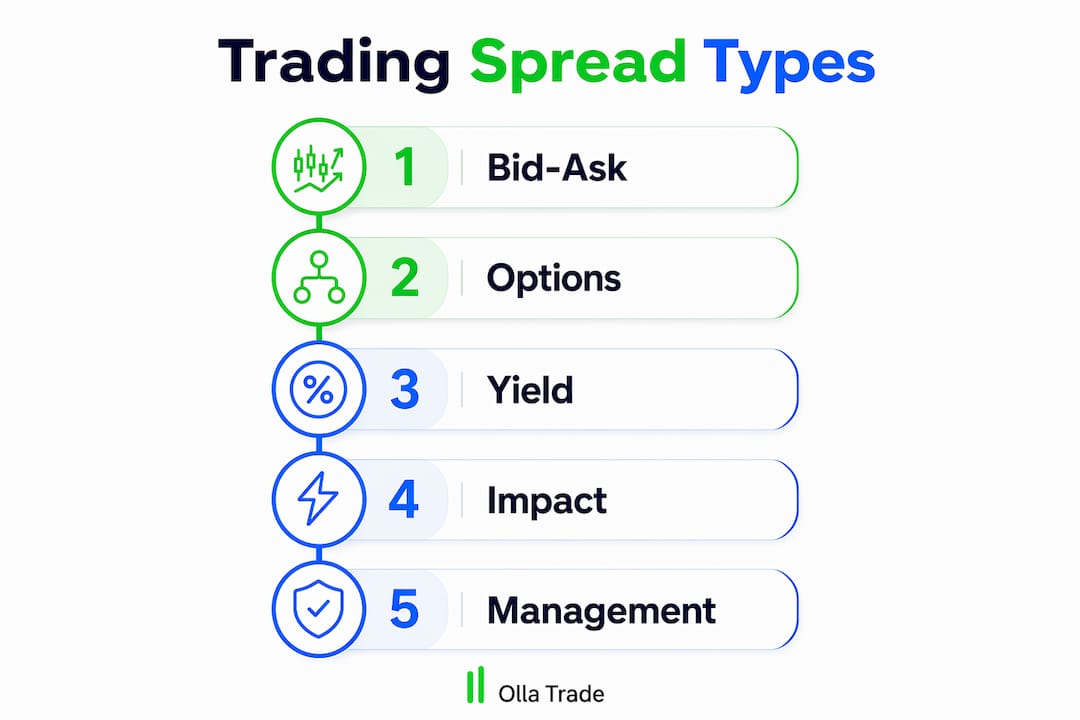
A spread in financial trading is the difference between two related prices or rates, and knowing how to understand spreads is the foundation of every cost-aware trading decision you will make. Three primary spread types shape how retail traders manage costs, control risk, and read market signals: the bid-ask spread, options spreads, and yield spreads. Each works differently, but all three directly affect your bottom line. Misreading any one of them can turn a well-planned trade into an unexpected loss.
What is the bid-ask spread and how does it affect your trades?
The bid-ask spread is the gap between the highest price a buyer will pay (the bid) and the lowest price a seller will accept (the ask). You pay this gap every time you enter or exit a trade. It is not a fee line on your statement. It is built into the price itself, which makes it easy to overlook and expensive to ignore.
Six factors determine how wide or narrow a bid-ask spread becomes at any given moment:
- Volume and open interest: High trading volume pulls more market participants in, which tightens spreads.
- Liquidity of the underlying asset: Heavily traded instruments like EUR/USD carry tighter spreads than thinly traded exotic pairs.
- Time to expiration: Options with more time left tend to have tighter spreads than those expiring soon.
- Strike distance: Options far from the current price carry wider spreads due to lower demand.
- Market conditions: Volatility events like central bank announcements push spreads wider fast.
- Market maker competition: More competing market makers means tighter quotes for you.
| Factor | Effect on spread |
|---|---|
| High volume and open interest | Narrows the spread |
| Low liquidity | Widens the spread |
| High market volatility | Widens the spread |
| Strong market maker competition | Narrows the spread |
| Far out-of-the-money strike | Widens the spread |
A narrow spread signals efficient, low-cost execution. A wide spread adds friction to every trade. That friction compounds quickly if you trade frequently or use tight profit targets.

Wide spreads create a problem that goes beyond entry costs. Wide spreads in illiquid markets can make cutting losses costly and slow your exits. You may want to close a losing position, but the spread means you sell at a worse price than you expected. This is how a manageable loss becomes a larger one.
Pro Tip: Check volume and open interest data before placing any options trade. High open interest on a strike price is a reliable signal that the spread will be tight and execution will be clean.
Pro Tip: Trade during peak market hours when liquidity is highest. For forex, that means the overlap between the London and New York sessions, roughly 8:00 AM to 12:00 PM ET.
How do options spreads work and why are they important for risk management?
Options spreads are multi-leg strategies where you simultaneously buy one option and sell another on the same underlying asset. The combination changes your risk profile in ways a single option cannot. Options spreads represent a shift from speculation to risk management by capping potential losses through these multi-leg structures.
The three main categories of options spreads are:
- Vertical spreads: Buy and sell options at different strike prices but the same expiration. A bull call spread, for example, caps both your maximum gain and your maximum loss.
- Horizontal (calendar) spreads: Buy and sell options at the same strike price but different expirations. These profit from changes in time decay.
- Diagonal spreads: Combine different strikes and different expirations. They offer more flexibility but require more active management.
A debit spread is the most common starting point for retail traders. You pay a net premium upfront, and that premium is your maximum possible loss. No matter how badly the trade moves against you, you cannot lose more than what you paid. That hard cap on loss is the core appeal for traders working with limited capital.
Selecting the right options spread comes down to a clear process:
- Define your market view. Are you bullish, bearish, or neutral on the underlying asset?
- Choose a spread type that matches that view. A bull call spread fits a moderately bullish outlook.
- Check the bid-ask spread on both legs before entering. Wide spreads on either leg inflate your cost.
- Calculate the maximum loss and maximum gain before placing the order.
- Set a plan for when you will exit, both if the trade wins and if it loses.
Pro Tip: Avoid options spreads on low-volume underlyings. Wide bid-ask spreads on both legs can eat most of your potential profit before the trade even moves in your favor.
Risk management in trading is not about avoiding losses entirely. It is about controlling how large those losses can get. Options spreads are one of the most direct tools retail traders have for doing exactly that.
What are yield spreads and how do they signal market conditions?
A yield spread is the difference in yield between two debt instruments, most commonly two bonds. The most widely watched example is the 10-year minus 2-year U.S. Treasury spread. This spread serves as a critical macroeconomic indicator. Traders, economists, and central banks all monitor it for signals about where the economy is heading.
The logic is straightforward. When long-term bonds yield more than short-term bonds, investors expect growth and are comfortable locking money away longer. When that relationship inverts, meaning short-term yields rise above long-term yields, it signals that investors expect economic trouble ahead. An inverted yield curve has preceded every U.S. recession in modern history.
| Yield spread condition | What it signals |
|---|---|
| Wide and widening spread | Strong growth expectations, risk appetite rising |
| Narrow spread | Uncertainty, slower growth expected |
| Inverted (negative) spread | Recession risk elevated, risk aversion high |
| Rapidly narrowing spread | Shift in market sentiment, watch for volatility |
Retail traders use yield spreads as a macro filter. If the 10-year minus 2-year spread is deeply inverted, that context should inform your risk exposure across equities, forex, and commodities. It does not tell you exactly when to trade. It tells you what kind of environment you are trading in.
Monitoring the economic calendar alongside yield spread data gives you a fuller picture. Treasury auctions, Federal Reserve meetings, and inflation reports all move yield spreads. Knowing when those events occur helps you anticipate spread shifts rather than react to them.
How to analyze spreads for better trading decisions
Spread analysis is a practical skill, not just a theoretical concept. Spreads widen during market uncertainty or geopolitical tension due to risk aversion. That widening is a signal, not just a cost. When you see bid-ask spreads expanding across multiple instruments simultaneously, the market is telling you that liquidity is leaving and volatility is rising.
A step-by-step framework for incorporating spread analysis into your trading routine:
- Monitor spread width at open. Compare the current bid-ask spread to the typical range for that instrument. A spread that is two or three times wider than normal is a warning sign.
- Check market depth alongside spread data. Market depth shows volume at different price levels. Thin depth combined with a wide spread means price can move sharply on small orders.
- Track yield spread trends weekly. Note whether the 10-year minus 2-year spread is widening or narrowing. Adjust your macro risk exposure accordingly.
- Review options spread costs before entering multi-leg trades. Add up the bid-ask spread cost on every leg. If total friction exceeds 20% of your maximum potential gain, reconsider the trade.
- Log spread conditions with each trade. Over time, your trade journal will show you which spread environments produce your best and worst results.
The most common mistakes retail traders make with spreads fall into two categories. The first is ignoring spread costs entirely and focusing only on price movement. The second is confusing spread types, for example, treating a widening bid-ask spread as a yield spread signal. Each spread type operates in a different context and requires a different response.
Spread analysis for trend prediction works best when combined with other tools. Pair spread monitoring with market trend analysis to confirm whether a widening spread reflects genuine volatility or just a temporary liquidity gap. The combination gives you a more reliable read on market conditions than either tool alone.
Pro Tip: When spreads widen sharply before a major news release, reduce your position size or wait for the announcement to pass. The cost of entering during peak spread widening often outweighs the benefit of early positioning.
Key takeaways
Understanding spreads means knowing which type you are reading, what drives its width, and how it affects your trade cost and risk exposure.
| Point | Details |
|---|---|
| Three spread types matter | Bid-ask, options, and yield spreads each serve a distinct function in trading. |
| Bid-ask spread is a direct cost | Every trade entry and exit carries this cost, built into the price itself. |
| Options spreads cap your losses | Multi-leg strategies limit maximum loss, making them vital for capital-limited traders. |
| Yield spreads signal macro risk | An inverted 10-year minus 2-year Treasury spread historically precedes economic contraction. |
| Spread widening is a warning | Rapidly widening bid-ask spreads signal rising volatility and falling liquidity. |
Why spread mastery separates consistent traders from the rest
After years of watching retail traders struggle with the same problems, the pattern is clear. Most losses that traders attribute to “bad luck” or “wrong direction” are actually spread problems in disguise.
The bid-ask spread is the one I see underestimated most often. Traders obsess over entry price and completely ignore the fact that they are already behind the moment they enter a trade. On a liquid forex pair, that cost is small. On a thinly traded options contract, it can be the difference between a profitable strategy and a losing one. I have seen traders run backtests that look great on paper, then wonder why live results disappoint. The answer is almost always spread friction that the backtest did not account for.
Options spreads changed how I think about risk entirely. The moment you accept that capping your maximum loss is worth giving up some upside, your trading psychology shifts. You stop hoping trades recover and start managing them with a clear plan. That shift is not just technical. It is the difference between trading with discipline and trading with anxiety.
Yield spreads are the most underused tool in the retail trader’s kit. Most traders ignore fixed-income signals entirely. That is a mistake. The 10-year minus 2-year Treasury spread is one of the most reliable macro indicators available, and it is free to monitor. Watching it alongside market volatility signals gives you context that pure price charts cannot provide.
The discipline that matters most is consistency. Check your spreads before every trade. Log the conditions. Review the data. Traders who build that habit find that their decision-making improves not because they found a new strategy, but because they stopped making the same avoidable mistakes.
— FX
Put your spread knowledge to work with Ollatrade
Knowing how spreads work is only useful when you can act on that knowledge in real markets.
Ollatrade gives retail traders access to forex markets with tight spreads and fast execution across major, minor, and exotic currency pairs. The platform integrates MetaTrader 4, which lets you monitor bid-ask spreads in real time, analyze market depth, and set up alerts for spread widening events. Ollatrade also provides an economic calendar, market news, and educational resources so you can track yield spread signals and apply options spread logic to your broader strategy. If you are ready to move from understanding spreads to trading them, start with the step-by-step forex guide on Ollatrade to build your first spread-aware trading plan.
FAQ
What is a spread in financial trading?
A spread is the difference between two related prices or rates. The three main types are the bid-ask spread, options spreads, and yield spreads, each serving a distinct role in trading costs and risk management.
How does the bid-ask spread affect my trading costs?
The bid-ask spread is built into every trade price. A narrow spread means low-cost execution, while a wide spread increases friction and can make profitable exits harder in illiquid markets.
What is an options spread and how does it limit risk?
An options spread combines buying and selling options on the same underlying asset. Debit spreads cap your maximum loss at the premium paid, making them a core risk management tool for retail traders with limited capital.
What does an inverted yield spread signal?
An inverted yield spread, where short-term Treasury yields exceed long-term yields, signals elevated recession risk. This condition has historically preceded economic contractions and warrants reduced risk exposure across asset classes.
When should I avoid trading due to spread conditions?
Avoid entering trades when bid-ask spreads are significantly wider than their normal range, particularly before major news releases or during low-liquidity periods. The added cost of wide spreads often outweighs the potential gain from early positioning.
Recommended
Articles are for informational and educational purposes only and do not constitute investment advice. Trading CFDs carries significant risk of loss. Past performance is not a reliable indicator of future results. Olla Trade Ltd. is an Anguilla registered entity.