
Your Investment Planning Workflow: A 2026 Step-by-Step Guide

A solid investment planning workflow follows five core stages: assess your finances, set time-bound goals, build an asset allocation plan, manage risk deliberately, and review on a regular schedule. The CFP Board’s 7-step financial planning process, updated in 2019 to include explicit fiduciary duties, is the professional compliance standard that credentialed planners follow. The CFA Institute adds a governance layer through the Investment Policy Statement (IPS), a written document that connects your goals to every portfolio decision. Neither framework is one-size-fits-all. Your income, timeline, tax situation, and emotional relationship with risk all shape how each step plays out.
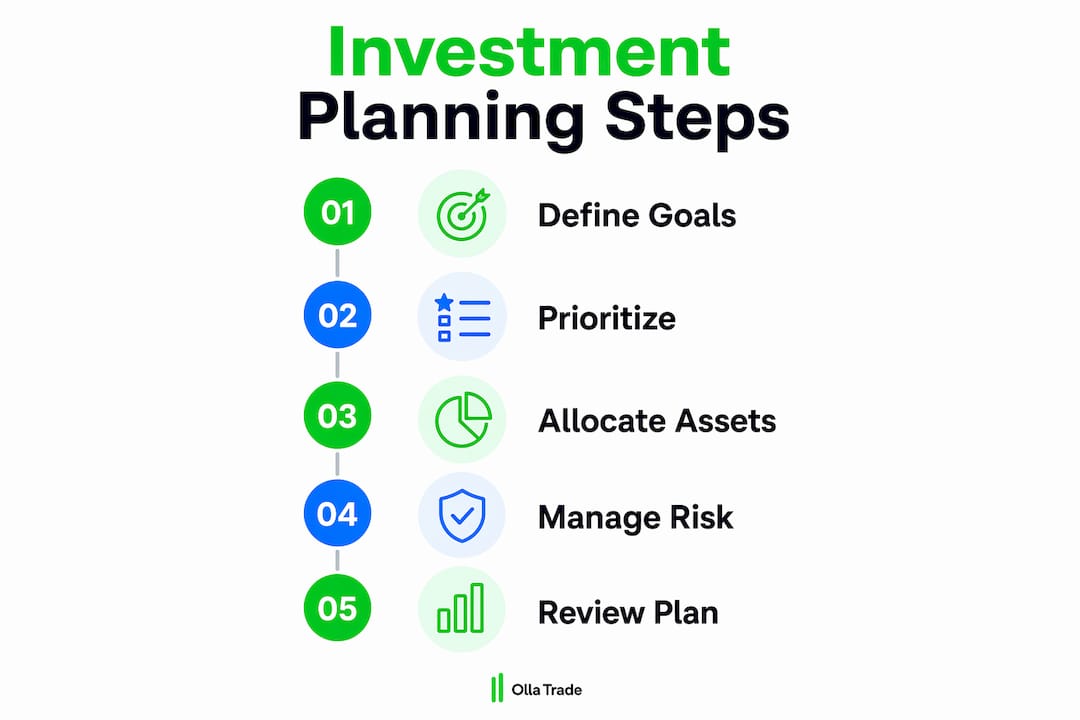
Here is the sequence at a glance:
- Step 1: Assess your current financial situation
- Step 2: Set clear, time-defined investment goals
- Step 3: Develop an asset allocation strategy
- Step 4: Implement risk management practices
- Step 5: Monitor, review, and adjust your plan
What does your investment planning workflow actually start with?
Before you pick a single fund or open a brokerage account, you need an honest picture of where you stand financially. That means building a complete inventory: monthly income, fixed and variable expenses, outstanding debt, insurance coverage, and the current value of every asset you own. Skipping this step is the most common reason plans fail within the first year.
A practical starting point is Fidelity’s 60/30/10+15 budgeting guideline: aim to allocate portions of your income toward essential expenses, nonessentials, near-term savings, and retirement. These are targets, not rigid rules, but they give you a baseline to measure against. If your current spending pattern is far off, that gap tells you exactly how much work the plan needs to do.
Debt and insurance belong in this assessment too. High-interest credit card debt tends to carry relatively high rates, which erode any investment return you might earn. Paying it down before investing additional dollars is usually the better move. Insurance coverage, including health, disability, and life, protects the financial foundation you are trying to build.
Actionable assessment steps:
- List every income source and calculate net monthly cash flow
- Catalog all assets (savings accounts, retirement accounts, real estate, vehicles) and liabilities (mortgage, student loans, credit cards)
- Check insurance coverage for gaps in health, disability, and life protection
- Identify how much you can realistically save each month after essential expenses
- Build or confirm an emergency fund covering 3–6 months of essential expenses before investing
Pro Tip: Before you touch investment accounts, make sure your emergency fund is in place. Liquidating investments early, especially in a down market, can permanently damage long-term returns.
How do you set investment goals that actually guide your decisions?
Goal clarity is what separates a financial plan from a wish list. The CFP Board framework requires that goals reflect your stated priorities, not a planner’s assumptions. That principle applies whether you work with a professional or build the plan yourself.
The most useful way to organize goals is by time horizon: short-term covers anything under 12 months, intermediate spans 1–10 years, and long-term extends beyond 10 years. Each category calls for a different investment approach. A down payment you need in three years cannot tolerate the same volatility as a retirement account you won’t touch for 25 years.
Common goals worth mapping explicitly:
- Retirement: The primary long-term goal for most investors; tax-advantaged accounts like 401(k) plans and IRAs are the anchor vehicles
- Home purchase: Typically intermediate-term; requires capital preservation over growth
- Education funding: Timeline is fixed by the child’s age, which makes it one of the more precise planning targets
- Wealth accumulation: Open-ended, but still needs a target amount and a target date to be useful
Once you have your list, rank the goals by priority and by the resources each one requires. When money is limited, this ranking prevents you from underfunding retirement to chase a shorter-term objective. It also shapes your risk tolerance: a goal with a 20-year runway can absorb more short-term volatility than one due in 18 months.
How should you build an asset allocation plan?
Asset allocation is where the financial planning process becomes concrete. Research shows that a very large portion of the variability in a fund’s return over time is explained by how its assets are allocated. The specific securities you pick matter far less than the mix of asset classes you hold.
The traditional building blocks are equities, fixed income (bonds), cash, and real estate. Within each class, you can diversify further by sector, geography, and market capitalization. A 30-year-old saving for retirement can reasonably hold a higher equity allocation than a 58-year-old approaching distribution. The CFA Institute frames this as a strategic asset allocation: a target mix derived from your objectives and constraints, with allowable ranges around each target.

Tactical allocation is a layer on top of that. It involves making deliberate, shorter-term shifts in response to market conditions, but it should never override the strategic baseline. Most individual investors are better served by staying close to their strategic targets and rebalancing when drift occurs than by trying to time markets through tactical moves.
Key principles for building your allocation:
- Match the equity-to-bond ratio to your time horizon and risk tolerance, not to what performed best last year
- Diversify across asset classes and within them (sectors, geographies, market caps)
- Account for tax location: hold tax-inefficient assets (like bonds) in tax-advantaged accounts when possible
- Use tax-smart techniques such as asset location, tax-efficient securities, and tax-loss harvesting to protect after-tax returns
- Document target allocations and acceptable drift ranges before you invest, not after
How do you manage risk without letting fear drive your decisions?
Risk management in an investment workflow has two distinct dimensions that investors frequently collapse into one: financial capacity and emotional tolerance. Financial capacity is your objective ability to absorb losses without derailing your goals. Emotional tolerance is how you actually behave when your portfolio drops 20% in a month. Both matter, and they often point in different directions.
The tool that bridges them is the Investment Policy Statement. The CFA Institute describes the IPS as a policy guide that provides an objective course of action during periods of market disruption, when emotional or instinctive responses might otherwise motivate less prudent decisions. Think of it as the rules you write for yourself when you are calm, so you don’t have to make them up when you are panicking.
A well-structured IPS uses the RRTTLLU framework: Return objectives, Risk objectives, Time horizon, Tax situation, Liquidity needs, Legal and regulatory constraints, and Unique circumstances. The first two are what you want to achieve; the remaining five are the limits within which you can pursue them. Documenting all seven prevents the kind of portfolio that looks great on paper but triggers impulsive selling the first time markets turn.
Pro Tip: Write your IPS before you invest, not during a correction. Investors who define their rebalancing triggers and risk limits in advance are far less likely to make decisions they regret.
Practical risk management steps:
- Separate your financial capacity from your emotional tolerance in writing
- Define rebalancing triggers (for example, a ±5% drift from target weights) in the IPS
- Build contingency scenarios: what happens to the plan if income drops, a major expense hits, or markets fall 30%?
- Review your risk exposure at least annually and after any major life event
- Avoid concentrating more than a small portion of the portfolio in any single security
Rebalancing is the mechanical side of risk control. Investors who skip it often end up with more equity exposure than they intended after a bull market, then experience more volatility than they anticipated when conditions reverse. Rebalancing back to target allocations helps keep the risk profile consistent with your agreed risk tolerance.
How often should you review and adjust your investment plan?
A plan you never revisit is just a document. The monitoring phase is where the personal finance workflow becomes an ongoing practice rather than a one-time event. The standard cadence is an annual review, plus a triggered review whenever a significant life event occurs: marriage, divorce, job change, inheritance, or the birth of a child.
Annual reviews should cover four things: performance relative to your benchmarks, whether your asset allocation has drifted from its targets, any changes in your tax situation, and whether your goals themselves have shifted. The last one is easy to overlook. A goal you set at 35 may look very different at 45, and the plan should reflect that.
Structured communication throughout the review process prevents the kind of drift that accumulates quietly over years. If you work with an adviser, that means documented meetings with written summaries. If you manage your own portfolio, it means keeping a log of every decision and the reasoning behind it. The log serves the same function as the IPS: it keeps you accountable to your past self.
Monitoring and revision checklist:
- Schedule a formal annual review with a fixed date on the calendar
- Compare portfolio performance against your stated benchmarks, not against whatever index was in the news
- Check allocation drift and rebalance if any asset class has moved outside its acceptable range
- Reassess your tax strategy: has your bracket changed, and are you using tax-advantaged accounts efficiently?
- Update the IPS whenever your objectives or constraints change materially
Cost management belongs in this phase too. Expense ratios, advisory fees, and transaction costs compound over time just as returns do. A fund charging 1% annually costs meaningfully more over 30 years than one charging 0.05%, even if their gross returns are identical. Reviewing costs annually and switching to lower-cost equivalents when appropriate is one of the highest-certainty improvements available to any investor.
What do experts recommend for a sound investment planning process?
The CFP Board’s 7-step framework, updated in 2019, is the operative professional standard in the United States. It runs from understanding the client’s circumstances through goal identification, analysis, recommendation development, presentation, implementation, and ongoing monitoring. The CFP Board stipulates that CFP® professionals must complete the first five steps in every qualifying engagement, with implementation and monitoring excluded only when explicitly agreed in writing.
The CFA Institute’s IPS governance framework adds a layer of accountability that the CFP process alone does not specify. The IPS documents who is responsible for determining investment policy, executing it, and monitoring results. For individual investors working without an institutional structure, that accountability falls entirely on you or your adviser, which makes the written document even more important, not less.
On timelines, the UN PRI’s investment strategy guidance recommends reviewing the overall strategy every 2–5 years as best practice, with the process itself spanning at least nine months for a thorough revision. That cadence applies to institutional asset owners, but the principle translates directly: investment strategy development is a long-term process, not a weekend project. Revisiting it every few years keeps the plan aligned with changing market conditions and personal circumstances.
Expert recommendations at a glance:
- Follow the CFP Board’s 7-step process as the compliance baseline for any comprehensive plan
- Document objectives and constraints in a written IPS before making allocation decisions
- Assess both financial capacity and emotional risk tolerance separately, and let both inform the portfolio design
- Engage structured communication throughout the planning cycle, especially when working with advisers or family members
- Review the full strategy every 2–5 years, and update the IPS whenever material circumstances change
Professional financial advice, when applied consistently, can add meaningfully to long-term portfolio returns. Industry estimates put that figure at up to 5.1% in additional returns over the long term, depending on the time period and how returns are calculated. Much of that value comes not from picking better securities but from keeping investors in the plan during periods when the instinct is to exit.
Ready to put your plan into action?
[IMAGE:cta_image]
Once your investment planning workflow is mapped out, the next step is choosing the right tools and markets to execute it. Ollatrade gives you access to forex, CFDs on metals, indices, stocks, energies, and cryptocurrencies through a platform built for both new and experienced investors. With MetaTrader 4 integration, real-time charting, and an economic calendar to track market-moving events, you have what you need to act on your plan with confidence. Explore forex trading on Ollatrade and see how the platform fits your investment strategy.
Key Takeaways
A structured investment planning workflow, grounded in the CFP Board’s 7-step process and CFA Institute IPS governance, gives you the framework to set goals, allocate assets, and manage risk without letting emotion drive the decisions.
| Point | Details |
|---|---|
| Start with a financial inventory | Map income, expenses, assets, and liabilities before making any investment decisions. |
| Categorize goals by time horizon | Short-term (under 12 months), intermediate (1–10 years), and long-term (beyond 10 years) goals each require a different allocation approach. |
| Asset allocation drives returns | Up to 90% of return variability is explained by asset allocation, not individual security selection. |
| Write an IPS before you invest | A formal Investment Policy Statement prevents emotional decisions during market volatility by documenting your rules in advance. |
| Review every 2–5 years | Best practice calls for a full strategy review every 2–5 years, plus annual check-ins and triggered reviews after major life events. |
Recommended
Articles are for informational and educational purposes only and do not constitute investment advice. Trading CFDs carries significant risk of loss. Past performance is not a reliable indicator of future results. Olla Trade Ltd. is an Anguilla registered entity.