
Order Types Explained: A Trader’s Complete Guide

TL;DR:
- Order types are predefined instructions that guide when and how brokers execute trades, including market, limit, and stop orders. They help traders control risk, timing, and entry prices, with advanced types like trailing stops and bracket orders offering greater automation. Choosing the appropriate order type depends on trading goals, market conditions, and risk tolerance to improve performance and reduce emotional decision-making.
Order types are predefined instructions that tell a broker when and how to execute a trade, covering the price, timing, and conditions of each transaction. The three primary categories recognized across financial markets are market orders, limit orders, and stop orders. Each one serves a distinct purpose, and choosing the wrong type at the wrong moment costs real money. This explanation of order types covers every major category, from the basics to advanced structures like bracket orders and trailing stops, so you can match each order to your actual trading intent.
What is the explanation of order types in trading?
An order type is the instruction set attached to every trade you place. It tells the market whether you want to execute immediately, wait for a specific price, or trigger automatically when conditions are met. Understanding order types is not optional for serious traders. It is the foundation of trade execution, and every professional uses this knowledge to control risk, timing, and entry price simultaneously.

The three core categories are market orders, limit orders, and stop orders. Each one trades off something: speed versus price certainty, or certainty versus execution guarantee. Advanced types like trailing stops and bracket orders build on these foundations. Knowing the order types definition for each category lets you build a trading plan that actually holds up under real market conditions.
What is a market order and when should traders use it?
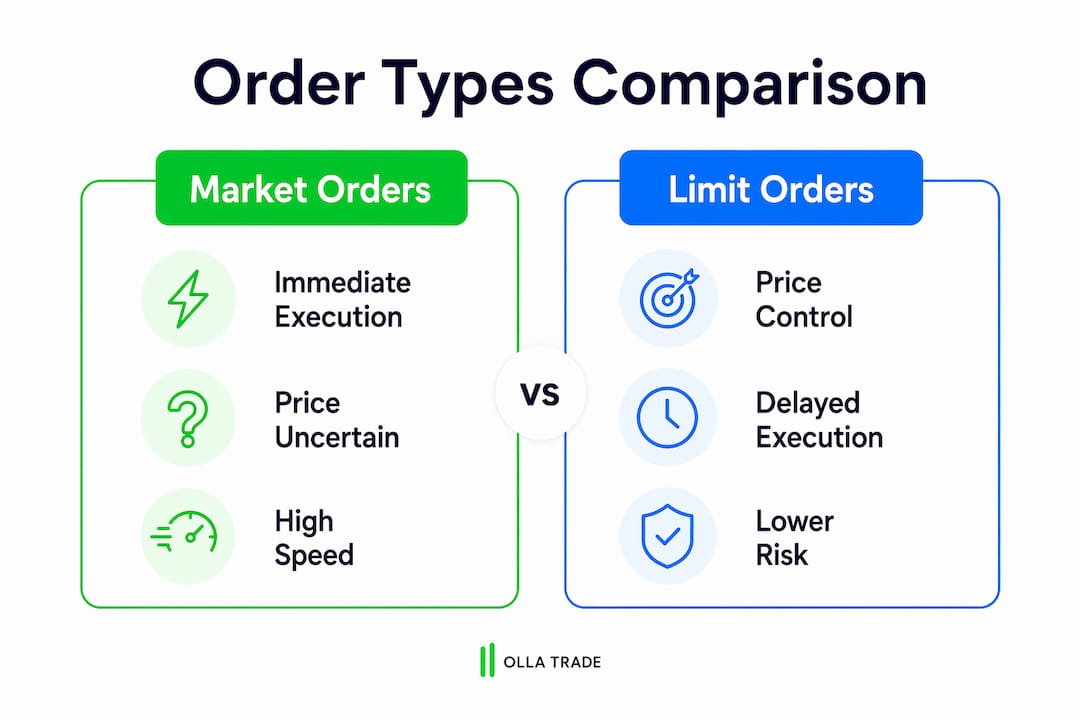
A market order is an instruction to buy or sell immediately at the best available price. Market orders provide instant execution with no price guarantee. That trade-off matters more than most beginners realize.
When market orders make sense
Market orders work best in three specific situations:
- High liquidity assets: Forex majors like EUR/USD, large-cap stocks, or major indices have tight bid-ask spreads. The gap between what you pay and the quoted price stays small.
- Urgent entries or exits: When a news event breaks and you need out of a position immediately, a market order gets you out. Waiting for a limit order to fill could cost far more than the spread.
- Momentum trades: If you are chasing a breakout and price is moving fast, a market order captures the move. A limit order below the breakout level may never fill.
The slippage risk you cannot ignore
Slippage is the difference between the price you expected and the price you actually received. In volatile markets or thinly traded assets, that gap widens fast. A market order during a major economic release can fill several pips away from the quoted price. This is not a platform error. It is the natural result of prioritizing speed over price.
Pro Tip: Never use a market order on a thinly traded asset during off-hours. The spread alone can eat a significant portion of your expected profit before the trade even starts.
How do limit orders work and what benefits do they provide?
A limit order specifies the maximum price you will pay to buy or the minimum price you will accept to sell. Limit orders offer price guarantee but no execution certainty. That second part is what trips up new traders.
Practical limit order scenarios
A buy limit order placed below the current price sits in the order book waiting. If price drops to your level, the order fills. If price never reaches that level, the order expires unfilled. This makes limit orders ideal for entering at support levels, targeting pullbacks in a trend, or buying at a specific valuation rather than chasing price.
A sell limit order works the same way in reverse. You set a target above the current price, and the order fills if price reaches it. Swing traders use this constantly to lock in profits at resistance levels without watching the screen all day.
Market orders vs. limit orders at a glance
| Feature | Market order | Limit order |
|---|---|---|
| Execution speed | Immediate | Only when price is reached |
| Price control | None | Full control |
| Execution guarantee | Yes | No |
| Best for | Urgent trades, liquid markets | Planned entries, specific price targets |
| Slippage risk | High in volatile markets | None (fills at limit price or better) |
Pro Tip: When placing a limit order near a key support or resistance level, add a few pips of buffer. Price often overshoots slightly before reversing, and a tight limit order misses the fill.
What are stop orders and how do they help manage risk?
A stop order becomes a market order once price hits a specified trigger level, called the stop price. Stop-loss orders trigger a market order after a security hits the stop price, helping traders limit downside risk or catch breakouts without constant monitoring. This is the most widely used risk management tool in active trading.
Two primary uses for stop orders
- Stop-loss protection: You buy EUR/USD at 1.0850 and place a stop-loss at 1.0820. If price drops to 1.0820, the stop triggers and closes your position, capping your loss at 30 pips.
- Breakout entry: You believe a stock will surge if it breaks above $50. You place a buy stop at $50.10. When price crosses that level, your order triggers and you enter the breakout automatically.
The critical limitation traders overlook
Stop-loss orders convert to market orders once triggered, which means execution price can deviate substantially from the stop price in fast-moving or illiquid markets. This is called slippage, and it is a real risk during earnings announcements, central bank decisions, or thin overnight sessions. A stop placed at $50 might fill at $49.60 if the market gaps through your level.
Stop-loss vs. stop-limit comparison
| Order type | Trigger | Execution type | Slippage risk | Execution guarantee |
|---|---|---|---|---|
| Stop-loss | Stop price hit | Market order | Yes | Yes (at market price) |
| Stop-limit | Stop price hit | Limit order | Minimal | No (may not fill) |
The stop-limit order solves the slippage problem by adding a price cap after the trigger. Once the stop price is hit, the order only fills at your limit price or better. The trade-off: if the market gaps past your limit, the order does not fill at all. For a deeper look at how stop orders fit into a full risk framework, the stop-loss risk management guide covers the mechanics in detail.
What are advanced order types and how do they enhance trading control?
Advanced order types build on the three core categories to give traders more automation and precision. They reduce emotional decision-making by locking in rules before the trade opens.
Trailing stops
Trailing stops adjust dynamically with price trends, moving the stop level as price moves in your favor. If you buy at $100 with a $5 trailing stop, the stop starts at $95. If price rises to $110, the stop moves to $105. If price then falls to $105, the order triggers and you exit with a $5 profit. The stop never moves backward. This lets you ride a trend without manually updating your stop every hour.
Bracket orders
Bracket orders automatically cancel remaining linked orders when one is executed. A bracket order packages three instructions together: an entry order, a take-profit limit order above entry, and a stop-loss below entry. When the take-profit fills, the stop-loss cancels automatically. When the stop-loss triggers, the take-profit cancels. This removes the risk of accidentally holding both exit orders open after one fills.
All-or-None orders
All-or-None orders must be filled completely or not at all, potentially causing missed opportunities in less liquid markets. AON orders work well when partial fills would create an unintended position size, but they carry real non-execution risk in thin markets.
Key advantages of advanced order types
- Automation: Trailing stops and bracket orders execute without you watching the screen.
- Emotional discipline: Predefined exits remove the temptation to hold a losing trade too long.
- Consistency: Rules-based order placement produces repeatable results across many trades.
- Risk definition: Bracket orders define maximum loss and target profit before the trade opens.
The main downside is complexity. Traders who layer advanced orders on top of a weak strategy still lose. Mastering market, limit, and stop orders first is the prerequisite. For disciplined trading practices and how advanced orders fit into a broader approach, Oracle’s trading insights offer a useful outside perspective.
How do you choose the right order type for your strategy?
The right order type depends on three variables: your priority between speed and price, your risk tolerance, and the current market conditions. Order types translate ideas into precise risk, timing, and execution. Treating them as mere settings rather than strategic decisions is the most common mistake retail traders make.
A practical decision framework
Match your order type to your primary trading intent:
- Speed is the priority: Use a market order. Accept the spread and potential slippage as the cost of certainty.
- Price is the priority: Use a limit order. Accept that the trade may not fill if the market does not reach your level.
- Risk control is the priority: Use a stop-loss or stop-limit. Decide in advance whether you need guaranteed exit (stop-loss) or price-controlled exit (stop-limit).
- Automation is the priority: Use trailing stops or bracket orders. These work best when you cannot monitor the market continuously.
Common mistakes to avoid
Beginners often place stop-loss orders too tight, triggering exits on normal price noise before the trade has room to develop. They also use market orders in illiquid conditions, paying wide spreads unnecessarily. Deliberate practice with small trades builds the intuition needed to understand how liquidity and volatility affect each order type in real conditions.
Pro Tip: Before scaling any strategy, run it with minimum position sizes for at least 20 trades. You will see exactly how your chosen order types behave under real market conditions, not just in theory.
The top trading tips for retail traders expand on this framework with specific examples across different market environments.
Key Takeaways
The best order type is the one that matches your trading intent precisely, not the most complex option available.
| Point | Details |
|---|---|
| Market orders prioritize speed | Use them in liquid markets when immediate execution matters more than price. |
| Limit orders guarantee price | They control your entry or exit price but carry no guarantee of execution. |
| Stop orders manage risk | Stop-loss orders trigger at market price; stop-limit orders add a price cap after the trigger. |
| Advanced orders reduce emotion | Trailing stops and bracket orders automate exits and remove in-the-moment decision-making. |
| Match order type to intent | Choose based on whether speed, price control, or automation is your primary need for each trade. |
Why order types are the most underrated trading skill
Most traders spend months studying chart patterns, indicators, and economic data. Very few spend equal time mastering order placement. That imbalance shows up in results.
The traders I have watched develop real consistency share one habit: they decide the order type before they decide the entry. They ask “how do I want this trade to execute?” before they ask “where do I enter?” That sequence matters. Choosing the order type first forces you to define your intent, your risk, and your exit before emotion enters the picture.
The trap I see most often is beginners jumping to advanced order types before they understand why a basic limit order did not fill. Trailing stops and bracket orders are genuinely useful tools, but they solve problems you have not encountered yet if you are still learning why slippage happens. Start with market and limit orders. Get comfortable with stop-losses. Then add complexity only when you have a specific problem that a simpler order type cannot solve.
The index trading strategies guide illustrates this well: the traders who outperform consistently are not the ones with the most complex setups. They are the ones who execute simple, well-chosen orders with discipline, trade after trade.
— FX
Put your order knowledge to work on Ollatrade
Ollatrade supports market, limit, stop-loss, stop-limit, trailing stop, and bracket orders across Forex, CFDs on metals, indices, stocks, energies, and cryptocurrencies. The platform integrates MetaTrader 4, giving you the full order type toolkit in a multi-device environment with fast execution and tight spreads.
Beginners can open a demo account to practice order placement without risk, testing how different order types behave across real market conditions. When you are ready to trade live, the Ollatrade Forex platform gives you access to all major order types with the execution speed and tools professional traders rely on. The step-by-step forex trading guide walks through order placement in detail for traders building their first structured approach.
FAQ
What is the simplest explanation of order types?
An order type is an instruction that tells your broker when and how to execute a trade, based on price, timing, or trigger conditions. The three core types are market, limit, and stop orders.
What is the difference between a limit order and a stop order?
A limit order executes only at your specified price or better, while a stop order triggers a market order once a set price is reached. Limit orders control price; stop orders control when a trade activates.
Do stop-loss orders guarantee my exit price?
No. Stop-loss orders convert to market orders once triggered, so the actual fill price can differ from the stop price, especially in fast-moving or illiquid markets.
When should a beginner use a market order?
Use a market order when you need immediate execution in a liquid market and the current spread is tight. Avoid market orders in volatile conditions or on thinly traded instruments where slippage risk is high.
What is a bracket order?
A bracket order links an entry order with a take-profit limit order and a stop-loss order. When one exit order fills, the other cancels automatically, removing the need to manage both exits manually.
Recommended
Articles are for informational and educational purposes only and do not constitute investment advice. Trading CFDs carries significant risk of loss. Past performance is not a reliable indicator of future results. Olla Trade Ltd. is an Anguilla registered entity.