
Position Trading: Your Complete Guide to Long-Term Strategies
Position trading is the practice of holding a trade for weeks, months, or even longer to capture a major market trend rather than reacting to daily price noise. Unlike day trading, where you open and close positions within hours, position trading lets the market do the heavy lifting over time. Position traders typically make fewer than 10 trades per year, relying on a blend of technical and fundamental analysis to identify high-conviction setups.
The strategy sits between swing trading and buy-and-hold investing on the time horizon spectrum. A swing trader might hold for days; a buy-and-hold investor may hold for decades. Position trading occupies the middle ground, targeting trends that play out over weeks to months. Risk control is non-negotiable here. Because you are exposed to the market for longer, a well-placed stop-loss is what separates a managed drawdown from a wrecked account.
Key attributes of position trading at a glance:
- Holds trades for weeks to months, targeting sustained trends
- Combines technical analysis (moving averages, RSI, MACD) with macro fundamentals
- Makes far fewer trades than day or swing trading
- Uses stop-losses and position sizing as primary risk controls
- Requires patience and psychological discipline over active monitoring
- Suits traders who cannot watch screens all day but want meaningful market exposure
What are the real advantages and disadvantages of position trading?
Position trading offers genuine benefits, but it comes with trade-offs that are easy to underestimate before you experience them firsthand.
Advantages:
- Less time at the screen. Once a position is open with defined stops and targets, you are not glued to charts. The time commitment drops sharply compared to shorter-term styles.
- Larger trend capture. You are fishing for the big moves, not the ripples. A trend that runs for several months can deliver multiples of what a day trader earns from dozens of smaller trades.
- Lower transaction costs. Fewer trades mean fewer commissions and less slippage over time.
- Reduced emotional noise. Hourly price swings stop mattering when your thesis plays out over weeks.
Disadvantages:
- Trend reversals. Minor fluctuations that you initially ignore can evolve into full trend reversals, turning a paper gain into a loss if your stop is too wide or misplaced.
- Capital tied up. Your money is committed for months. If a better opportunity appears, you may not have the capital to act on it.
- Overnight and weekend risk. Gaps on open can jump past your stop-loss, especially in forex and commodities.
- Swap costs on leveraged products. Holding a leveraged position overnight accumulates swap fees that erode returns over long holding periods, a cost that short-term traders rarely face.
The psychological side deserves its own mention. Watching a position move against you for two weeks while trusting your thesis requires a level of patience that most traders discover they do not have until they are tested. That patience, combined with strict risk rules, is what separates consistent position traders from those who abandon the strategy after one bad trade.
Which strategies and tools do position traders actually use?
Position trading is not one strategy. It is a time horizon applied to several distinct approaches, each with its own tools and logic.
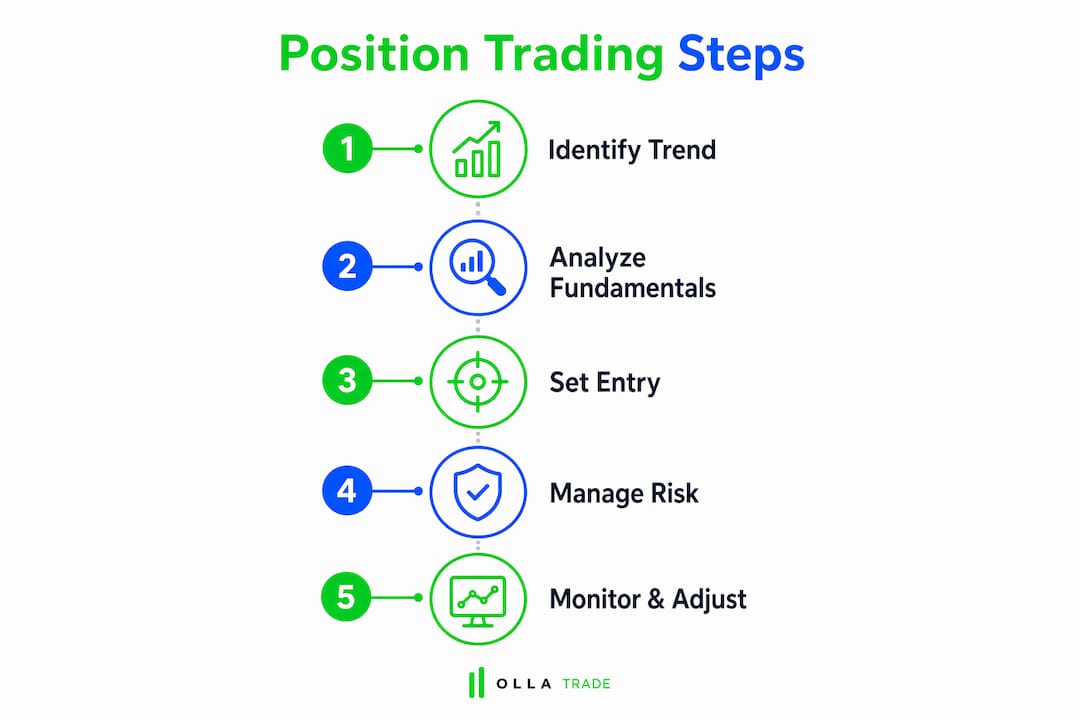
Trend following on higher timeframes. The most common approach. You identify a trend on the weekly or monthly chart, wait for a pullback or consolidation on the daily chart, and enter in the direction of the larger move. Moving averages like the 50-week and 200-week are the backbone of this method, acting as dynamic support and resistance levels.

Macro-driven fundamental trading. You form a view on an economy, sector, or commodity based on interest rates, GDP growth, or supply-demand dynamics, then use technical analysis to time the entry. A trader who believes the U.S. dollar will strengthen over six months due to Federal Reserve policy would look for a technical entry on a dollar-denominated pair rather than buying blindly.
Breakout trading. Price consolidates in a range for weeks, then breaks out with conviction. Position traders enter on the breakout and hold through the trend, using the prior range as a reference for stop placement.
Key tools position traders rely on:
- RSI on weekly charts to identify overbought or oversold conditions before entry
- MACD for momentum confirmation and divergence signals
- Trend lines) drawn on weekly and monthly charts to define the structure of a move
- Economic calendars to track macro events that could invalidate a thesis
- Position sizing calculators to match trade size to stop distance
Pro Tip: Treat your stop-loss as the point where your trade thesis is proven wrong, not as an arbitrary dollar amount you are willing to lose. Size your position from the stop distance so the risk per trade stays consistent regardless of how wide the stop needs to be.
Combining macro and technical analysis gives you two independent reasons to be in a trade, which is far more durable than either approach alone.
How does position trading look in practice?
Two scenarios illustrate how the strategy plays out, one favorable and one adverse.
Scenario 1: Trend following a commodity.
A trader notices crude oil has been making higher highs and higher lows on the weekly chart for three months. The 50-week moving average is sloping upward, and a macro backdrop of supply cuts supports the bullish thesis. The trader enters on a daily chart pullback to the 50-day moving average, places a stop below the most recent weekly swing low, and targets the prior multi-month high. Six weeks later, oil reaches the target. The stop was never threatened.

Scenario 2: A trend reversal scenario.
A trader enters a long position on a stock index after a breakout from a multi-week consolidation. The position moves in favor for two weeks, then a surprise central bank announcement triggers a sharp selloff. The index gaps below the stop-loss on open, and the trade closes at a loss slightly worse than planned due to the gap. The pre-set stop limited the damage to a manageable percentage of the account.
What these examples show:
- Entry is based on a defined technical trigger, not a feeling
- Stop placement is structural, tied to a chart level, not an arbitrary dollar amount
- The adverse scenario still results in a controlled loss because the stop existed
- Position trading differs from swing trading in that the target and holding period are measured in weeks, not days
The difference from day trading is even starker. A day trader in the same crude oil market might take 15 trades in the time a position trader holds one, with far smaller targets per trade and no overnight exposure. Neither approach is superior in absolute terms; they suit different temperaments and schedules.
How do you start position trading as a beginner?
Position trading is genuinely suitable for beginners who prefer fewer decisions and less screen time, but that accessibility comes with a condition: risk management must be non-negotiable from day one.
Start here:
- Define your investment horizon before you enter any trade. Are you targeting a two-month trend or a six-month macro move? The answer shapes your chart timeframe, stop distance, and position size.
- Use a demo account first. Practice identifying trends on weekly charts, placing stops at structural levels, and sizing positions correctly before real capital is at risk.
- Start with liquid, well-understood markets. Major forex pairs, large-cap stock indices, and gold are more predictable in their trend behavior than exotic instruments.
- Pre-set your stop-loss and take-profit before entering. Beginners who skip this step tend to move stops when the trade goes against them, turning small losses into large ones.
- Keep a trade journal. Record your thesis, entry, stop, target, and outcome for every trade. Patterns in your mistakes become visible within a few months.
The risk management principles that matter most for beginners are straightforward: never risk more than a fixed percentage of your account on a single trade, and size every position from the stop distance rather than from a gut feeling about how much you want to make.
Ollatrade’s platform gives you access to MetaTrader 4, which includes built-in charting across multiple timeframes, one-click stop-loss placement, and expert advisors that can automate parts of your trade management. For beginners learning to manage positions over longer periods, having those tools in one place removes a lot of friction.
Pro Tip: Reduce your trade frequency deliberately when starting out. One well-researched position trade per month teaches you more about patience and risk discipline than ten rushed ones.
What position traders need to know about taxes
Position trading has real tax consequences in the United States, and the holding period is the single most important variable.
The IRS distinguishes between short-term and long-term capital gains based on how long you hold an asset. Positions held for more than one year qualify for long-term capital gains rates, which are generally lower than ordinary income tax rates. Positions held for one year or less are taxed as short-term capital gains at your ordinary income rate. Since many position trades close within weeks to months, most fall into the short-term category.
Forex trading adds complexity. Spot forex transactions for retail traders in the U.S. are typically treated under Section 988 of the Internal Revenue Code, which taxes gains as ordinary income regardless of holding period. Traders can elect out of Section 988 treatment under certain conditions, but this requires documentation and should be discussed with a qualified tax professional before trading begins.
CFDs and futures have their own treatment. Futures contracts often fall under Section 1256, which applies a blended 60/40 rule: 60% of gains are treated as long-term and 40% as short-term, regardless of actual holding period. This can be favorable for active traders.
Accurate record-keeping is not optional. Every trade entry, exit, date, and profit or loss must be documented. Most trading platforms, including Ollatrade, generate transaction histories that simplify this process, but the responsibility for accurate tax reporting rests with the trader. Consulting a tax professional who specializes in trading income is the most reliable way to avoid costly errors.
Key Takeaways
Position trading rewards patience and disciplined risk management more than raw market knowledge.
| Point | Details |
|---|---|
| Holding period defines the style | Position traders hold for weeks to months, targeting sustained trends rather than short-term moves. |
| Stop-loss as thesis invalidation | Place stops at structural chart levels; size positions from the stop distance to keep risk consistent. |
| Fewer trades, bigger targets | Position trading typically involves fewer than 10 trades per year, focusing on capturing major trend moves. |
| Tax treatment varies by instrument | U.S. forex spot trades fall under Section 988 ordinary income rules; futures may qualify for the 60/40 Section 1256 treatment. |
| Beginners can start here | Position trading suits those who prefer fewer decisions, but strict pre-set risk controls are required from the first trade. |
Ready to put these principles into practice? Ollatrade gives you access to forex markets with tight spreads, MetaTrader 4 integration, and the charting tools position traders rely on across weekly and monthly timeframes. If you are just getting started, the step-by-step forex guide walks you through account setup, trade execution, and risk controls in plain language.
Recommended
Articles are for informational and educational purposes only and do not constitute investment advice. Trading CFDs carries significant risk of loss. Past performance is not a reliable indicator of future results. Olla Trade Ltd. is an Anguilla registered entity.