
Positions in Trading: Types, Strategies, and Risk Management
What are positions in trading?
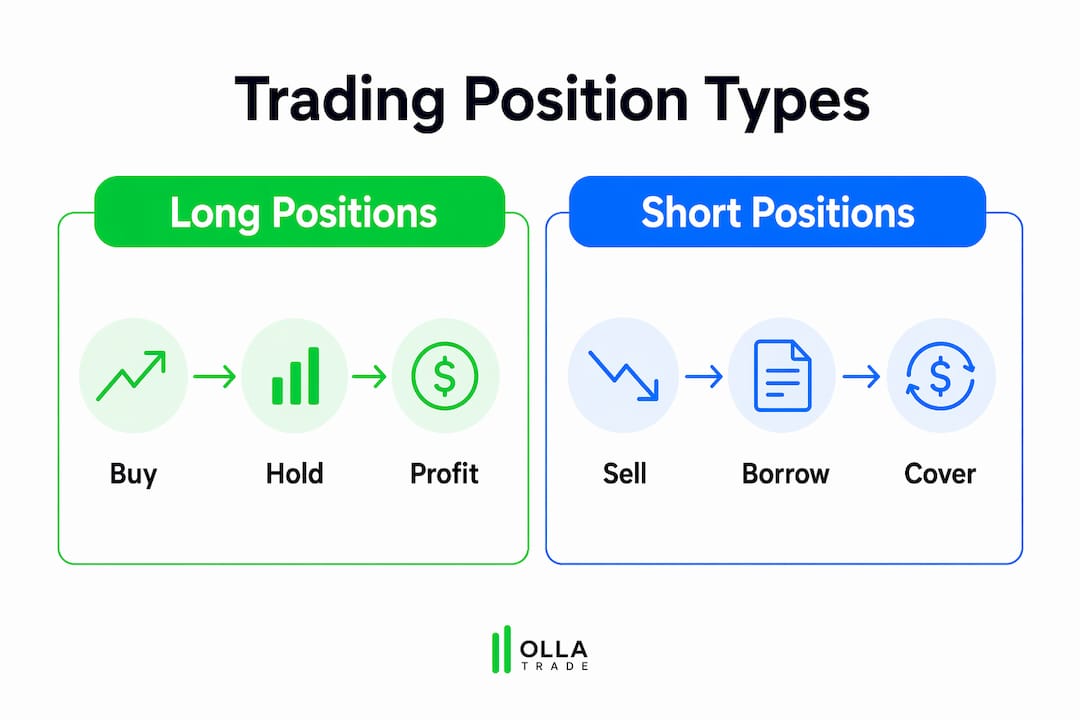
A trading position is the amount of exposure you hold in a financial asset, whether through ownership or a contractual obligation. According to Investor.gov, a long position means you own the security; a short position means you have sold it without owning it. In futures and CFDs, a position is a binding commitment rather than outright ownership, which changes the risk profile considerably.
Every position is either open or closed. An open position carries market risk until you execute an equal and opposite transaction to close it. Until that moment, any profit or loss is unrealized.
The main types of trading positions you need to know:
- Long position: You buy an asset expecting its price to rise.
- Short position: You sell an asset you do not own, expecting its price to fall.
- Bull position: You benefit when the underlying price goes up.
- Bear position: You benefit when the underlying price goes down.
- Net position: The difference between your total open long and short positions in a given asset.
Understanding which type of position you hold at any moment is the foundation of every trading decision you make.
How long and short positions actually work
Long and short are the two fundamental positions in trading, and every other classification builds on them.

Going long is straightforward. You buy an asset, say 100 shares of a stock at $50, and hold it. If the price climbs to $70, you sell and pocket a $20-per-share gain. Your maximum loss is limited to what you paid. Most retail investors spend their entire careers exclusively in long positions.
Going short works in reverse, and the mechanics are worth understanding clearly:
- You borrow shares from a broker and sell them at the current market price.
- If the price falls, you buy the shares back at the lower price.
- You return the borrowed shares and keep the difference as profit.
- If the price rises instead, your losses can theoretically be unlimited since there is no ceiling on how high a price can go.
A practical example: you short 100 shares of a stock at $80. The price drops to $55. You buy back at $55, return the borrowed shares, and net $25 per share. But if the stock jumps to $120, you face a $40-per-share loss with no automatic exit unless you have a stop-loss in place.
In forex trading, the same logic applies. Going long on EUR/USD means you expect the euro to strengthen against the dollar. Going short means you expect it to weaken. The buying and selling positions in forex happen simultaneously since every currency pair involves buying one currency and selling another.
Pro Tip: Short selling is generally considered more advanced than going long. If you are new to trading, get comfortable with long positions and basic risk management before attempting to short any asset.
Bull, bear, and net positions explained
Bull and bear positions describe your directional bias, while net position tells you your overall exposure.
- Bull position: You profit when the underlying asset’s price rises. This is typically equivalent to a long position on stocks or forex, but it can also mean holding a short position on a put option or an inverse ETF.
- Bear position: You profit when the price falls. This usually means holding a short position, but a long put option also qualifies as a bear position.
- Net position: Calculated as total long exposure minus total short exposure in the same asset. If you hold $10,000 long in a stock and $4,000 short in the same stock, your net position is $6,000 long.
Beyond directional bets, traders can also hold neutral positions that are designed to be unaffected by price movement. These delta-neutral setups profit from other variables like volatility or interest rates rather than the direction the market moves. Options traders use them frequently.
Net position matters most when you are managing a portfolio with multiple trades open at once. A trader who is long crude oil futures and short an energy ETF may think they are hedged, but the net position reveals the actual directional exposure. Tracking it prevents surprises when the market moves sharply.
Position trading as a long-term strategy
Position trading is a style where you hold trades for weeks, months, or even years, riding major market trends rather than reacting to daily price swings. Active trading styles range from scalping (seconds to minutes) to day trading (same day) to swing trading (days to months), with position trading sitting at the far end of the holding-period spectrum.
Position traders focus on macroeconomic trends and fundamental analysis. They are not watching tick charts. They are reading central bank policy, earnings cycles, and commodity supply data to identify where a market is heading over the next quarter or year.
Advantages of position trading:
- Less time in front of screens compared to day trading or scalping.
- Potential to capture large, sustained price moves.
- Lower transaction costs since you trade less frequently.
- Reduced impact from short-term noise and volatility.
Disadvantages of position trading:
- Capital is tied up for extended periods, limiting flexibility.
- Overnight and weekend risk exposure accumulates over time.
- Requires patience; profits can take months to materialize.
- Drawdowns can be deep before a trend fully develops.
For a direct comparison, consider how different CFD trading strategies handle time. A day trader in CFDs closes every position before the market closes, eliminating overnight risk entirely. A position trader in the same CFD market might hold through several earnings reports and central bank meetings. The risk profile is fundamentally different, not just in duration but in the type of analysis required.
Position trading suits traders who have conviction in a macro thesis and the discipline to hold through short-term volatility without abandoning the trade prematurely.
How to manage and size your positions effectively
Good position management separates traders who survive long-term from those who blow up their accounts on a few bad trades. The mechanics are not complicated, but they require consistent application.

Position sizing using the 2% rule:
Keeping each position below a small percentage of your total portfolio is a widely recommended practice for retail traders to limit risk on any single trade. This limit ensures that even a string of losses does not wipe out your capital before you can recover.
Core risk management tools:
- Stop-loss orders: Stop-losses limit your losses by automatically closing a position when the price reaches a predefined level. They are the single most practical tool for controlling downside on open trades.
- Diversification: Holding positions across different sectors and asset classes smooths out risk. If one sector collapses, positions in unrelated markets can offset the damage.
- Defined entry and exit rules: Effective trading strategies include objective, measurable rules for when to enter and when to exit, reviewed and updated as market conditions change. Vague plans lead to emotional decisions.
Adjusting positions as conditions change:
Markets shift. A position that made sense when you opened it may need to be reduced, hedged, or closed as new data arrives. Scaling out of a winning position gradually, rather than exiting all at once, is one way to lock in gains while staying exposed to further upside.
A solid risk management approach also means knowing your maximum acceptable loss before you enter any trade. Set that number in advance, not in the middle of a drawdown when emotions run high.
Pro Tip: Over-leveraging is the fastest way to turn a sound trading idea into a catastrophic loss. Understanding trading leverage means knowing not just what leverage amplifies your gains, but exactly how much it amplifies your losses. Size positions so that even your worst-case scenario is survivable. Check the trader risk management checklist to build a consistent pre-trade routine.
Ready to put these concepts into practice? Ollatrade gives you access to forex markets and a full suite of CFD instruments, with the tools and execution speed to manage positions across multiple asset classes from a single platform.
Key Takeaways
Mastering positions in trading requires understanding each position type, choosing a strategy that fits your time horizon, and applying consistent risk management rules before every trade.
| Point | Details |
|---|---|
| Long vs. short positions | Long positions profit from rising prices; short positions profit from falling prices, with theoretically unlimited loss potential. |
| Bull, bear, and net positions | Bull and bear describe directional bias; net position reveals your true overall exposure after combining longs and shorts. |
| Position trading time horizon | Position trading holds trades for months or years, focusing on macroeconomic trends rather than short-term price moves. |
| The 2% rule for sizing | Keeping each position below 2% of total portfolio value limits the damage any single losing trade can cause. |
| Stop-losses and diversification | Stop-loss orders and holding positions across different sectors are the two most practical tools for managing open position risk. |
Recommended
Articles are for informational and educational purposes only and do not constitute investment advice. Trading CFDs carries significant risk of loss. Past performance is not a reliable indicator of future results. Olla Trade Ltd. is an Anguilla registered entity.