
Step by Step Portfolio Diversification: Your 2026 Guide

TL;DR:
- Diversification involves spreading investments across various assets to lower risk and boost long-term returns. Making disciplined, incremental adjustments ensures portfolio resilience through economic cycles and reduces emotional bias.
Step by step portfolio diversification is the methodical process of spreading investments across multiple asset classes and securities to reduce risk and improve long-term returns. The industry term for this practice is asset allocation, and it sits at the core of Modern Portfolio Theory, which proves that combining low-correlation assets reduces portfolio risk without sacrificing expected returns. Whether you manage $10,000 or $10 million, a structured approach to diversification separates investors who survive market downturns from those who don’t. This guide walks you through every stage, from setting goals to rebalancing, so you can build a portfolio that works across economic cycles.
What foundational elements must you establish before diversifying?
Effective diversification starts before you buy a single security. You need three things locked in first: your financial goals, your time horizon, and your true risk tolerance.

Financial goals and time horizon determine which asset classes belong in your portfolio. A goal five years away calls for a very different allocation than one 30 years out. For goals within five years, equities are generally discouraged because short-term volatility can permanently impair capital you need soon. Longer horizons give equities time to recover from drawdowns and compound.
Risk tolerance has two dimensions most investors underestimate. The first is financial capacity: how much loss your portfolio can absorb without derailing your goals. The second is psychological tolerance: how much drawdown you can stomach before panic-selling. Many investors discover their psychological limit is far lower than their financial capacity. Knowing both prevents you from building a portfolio you’ll abandon at the worst moment.
Asset classes are the building blocks of any diversified portfolio. Understanding their distinct risk and return profiles is non-negotiable before allocating capital. Equities offer high long-term growth with high short-term volatility. Bonds provide income and stability but limited growth. Real estate, commodities, and alternative assets each respond differently to inflation and economic cycles.
Tax-advantaged accounts belong in your setup before you open a taxable brokerage account. Accounts like 401(k)s and IRAs compound returns faster because taxes don’t erode gains annually. Fill these first, then invest in taxable accounts with whatever remains.
- Define at least two specific financial goals with target dates and dollar amounts.
- Assess both your financial and psychological risk tolerance separately.
- Learn the basic asset correlation between your intended holdings before buying.
- Prioritize tax-advantaged accounts (401k, IRA) before taxable brokerage accounts.
- Choose a brokerage that offers broad ETF access with low or zero commissions.
Pro Tip: Write your goals and risk tolerance on paper before logging into any brokerage. Investors who articulate their plan in writing are far less likely to deviate from it during market stress.
What are the six steps to implement portfolio diversification?
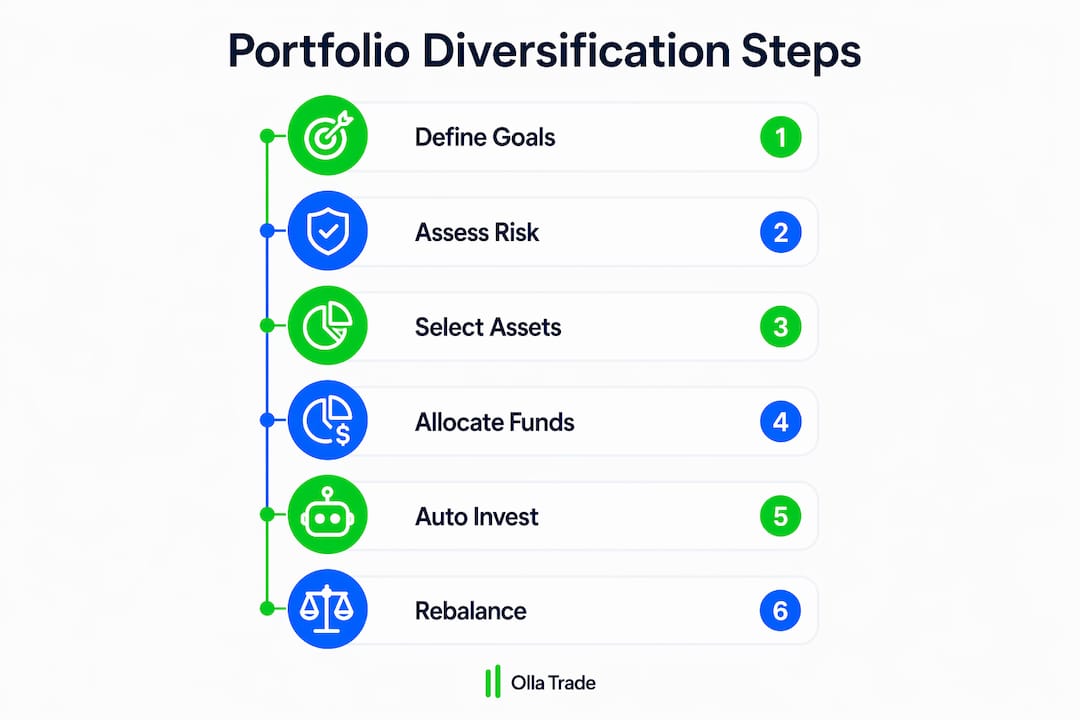
A structured, stepwise investment strategy removes guesswork and emotional decision-making from the process. These six steps follow the sequence that professional advisors use with clients at every wealth level.
-
Define goals and time horizons for each portfolio segment. Treat each goal as a separate “bucket.” Retirement in 30 years gets an aggressive equity allocation. A home down payment in four years gets cash and short-term bonds. Mixing goals into one undifferentiated portfolio is the most common structural mistake investors make.
-
Calculate your target asset allocation. A common starting framework is subtracting your age from 110 to get your equity percentage, with the remainder in bonds and alternatives. Adjust this based on your risk tolerance assessment. A 35-year-old with high risk tolerance might hold 80% equities, 10% bonds, and 10% alternatives.
-
Choose a low-cost brokerage with broad ETF access. Brokerage fees compound against you just as returns compound for you. A platform charging 0.5% annually in hidden costs can erase years of diversification benefit. Look for zero-commission ETF trading and a wide selection of index funds.
-
Maximize tax-advantaged accounts before taxable ones. Contribute the full employer match to your 401(k) first. Then max your IRA. Only after exhausting these should capital flow into a taxable brokerage account. This sequencing materially improves long-term compounding.
-
Purchase core ETFs aligned with your allocation targets. A three-fund portfolio covering U.S. equities, international equities, and bonds covers the major asset classes with minimal complexity. Time in the market consistently outperforms attempts to time the market. Buy your target allocation and hold it.
-
Automate monthly contributions through dollar-cost averaging. Dollar-cost averaging automatically buys more shares when prices are low and fewer when prices are high. This removes emotional bias from investment timing and improves your average purchase price over full market cycles.
| Step | Action | Practical tip |
|---|---|---|
| 1. Define goals | Set target dates and dollar amounts per goal | Treat each goal as a separate portfolio bucket |
| 2. Set allocation | Calculate equity vs. bond vs. alternative split | Use age-based formulas as a starting point |
| 3. Choose brokerage | Select low-cost platform with broad ETF access | Compare total cost of ownership, not just commissions |
| 4. Use tax-advantaged accounts | Max 401(k) match, then IRA, before taxable accounts | Prioritize accounts where gains compound tax-free |
| 5. Buy core ETFs | Purchase index funds matching your allocation | A three-fund portfolio covers most investors’ needs |
| 6. Automate contributions | Set up recurring monthly investments | Dollar-cost averaging removes emotional timing bias |
Pro Tip: Set your monthly contribution to auto-invest on the same day you receive your paycheck. Paying yourself first before discretionary spending is the single most reliable way to build wealth consistently.
How to maintain and optimize your diversified portfolio over time?
Building a diversified portfolio is a one-time event. Maintaining it is an ongoing discipline. Markets move, and your allocation drifts away from its targets over time.
Rebalancing is the mechanism that keeps your portfolio aligned with your goals. Vanguard research supports rebalancing once or twice annually, or whenever any asset class drifts more than 5% from its target. Both approaches produce similar long-term outcomes. The key is consistency, not frequency.
Diversification across multiple dimensions separates adequate portfolios from genuinely resilient ones. True diversification spans asset classes, sectors, geographies, and investment styles. A portfolio holding only U.S. large-cap growth stocks is not diversified, even if it contains 50 different companies. Add international exposure, small-cap value, real estate investment trusts, and dividend payers to cover different economic regimes.
Dividend-paying stocks deserve specific mention here. Dividend payers skew toward older-economy, defensive sectors that behave differently than growth stocks during market stress. Adding them to a growth-heavy equity portfolio reduces volatility without abandoning equities entirely.
- Rebalance annually or when any position drifts more than 5% from its target weight.
- Review your allocation whenever your life circumstances change significantly (new job, marriage, child, approaching retirement).
- Monitor asset correlation periodically. Correlations between asset classes shift during market crises, often when you need diversification most.
- Avoid rebalancing too frequently. Excessive trading generates costs and tax events that erode returns.
- Adjust your equity-to-bond ratio gradually as you approach each goal’s target date.
Pro Tip: Use new contributions to rebalance before selling existing holdings. Directing new money toward underweight positions avoids triggering taxable events and keeps transaction costs near zero.
| Rebalancing trigger | Frequency | Trade-off |
|---|---|---|
| Calendar-based | Once or twice per year | Simple to execute; may miss large drifts mid-year |
| Threshold-based (5% drift) | As needed | More precise; requires regular monitoring |
| Hybrid approach | Annual review plus 5% threshold | Balances simplicity with responsiveness |
What common mistakes do investors make when diversifying stepwise?
Most diversification mistakes share a common root: confusing quantity with quality. Owning 100 stocks does not mean you are diversified.
Modern Portfolio Theory defines diversification by correlation, not count. If your 100 stocks are all in the technology sector, they will fall together during a tech selloff. True risk reduction requires assets that respond differently to the same economic event. A portfolio of U.S. tech stocks, international equities, bonds, and real estate holds four genuinely different risk exposures.
“Diversification is a continuous construction process designed to manage risk across different economic regimes. No single market cycle should be able to sink the portfolio.” — Jeff Porter, CFA and CFP, Creative Planning
A second common error is over-allocating to bonds when retirement is decades away. Bonds reduce volatility, but they also cap long-term growth. An investor with 30 years until retirement who holds 50% bonds will likely retire with significantly less wealth than one who held 80% equities and rebalanced consistently.
Investors also make the mistake of ignoring value investing pitfalls that can undermine even a well-structured diversification plan. Chasing recent winners, anchoring to purchase price, and neglecting sector concentration within a “diversified” value portfolio all erode the benefits of a sound allocation framework.
The final mistake is treating diversification as a return-maximization tool. It is not. Diversification is a risk management tool. Its purpose is to reduce the severity of drawdowns and smooth the path to your goals. Accepting that a diversified portfolio will sometimes underperform a concentrated one during bull markets is the psychological cost of long-term resilience.
Key Takeaways
Effective portfolio diversification requires defining clear goals, selecting low-correlation assets across multiple dimensions, and maintaining discipline through automated contributions and consistent rebalancing.
| Point | Details |
|---|---|
| Correlation beats quantity | True diversification requires assets that respond differently to economic events, not just more holdings. |
| Tax sequencing matters | Max tax-advantaged accounts before taxable ones to accelerate long-term compounding. |
| Automate contributions | Dollar-cost averaging removes emotional bias and improves average purchase price over time. |
| Rebalance consistently | Annual or threshold-based rebalancing keeps your allocation aligned with your goals without excessive trading. |
| Diversification manages risk | Its primary purpose is reducing drawdown severity, not maximizing returns. |
Why I think most investors overcomplicate this process
The investors I’ve seen succeed long-term are almost never the ones with the most sophisticated portfolios. They’re the ones who built a simple, well-structured plan and stuck to it through multiple market cycles.
The most common failure mode I observe is paralysis by complexity. Investors spend months researching the perfect allocation, miss a year of compounding, and then abandon the plan the first time markets drop 15%. A three-fund portfolio held for 20 years with consistent contributions will outperform most actively managed strategies. The math on this is not close.
What actually separates successful investors is alignment between their portfolio and their emotional risk tolerance. A portfolio you’ll hold through a 30% drawdown is worth more than a theoretically optimal one you’ll sell at the bottom. Knowing yourself matters as much as knowing asset classes.
Automation is the single most underrated tool in long-term investing. Setting up automatic monthly contributions removes the decision entirely. You don’t have to feel confident about markets to invest. The system invests for you, and time does the rest.
— FX
How Ollatrade supports your portfolio diversification goals
Ollatrade gives retail and professional investors access to a broad range of trading instruments including forex, CFDs on metals, indices, stocks, energies, and cryptocurrencies, all from a single platform. For investors looking to extend their diversification beyond traditional equities and bonds, currency markets and commodity CFDs offer exposure to economic forces that move independently of stock markets.
The platform integrates MetaTrader 4 with advanced charting tools and expert advisors, giving you the infrastructure to monitor and manage a multi-asset portfolio with precision. Ollatrade’s forex trading resources and educational guides help investors understand how currency exposure and alternative instruments fit into a broader diversification strategy. Open an account and start building a more complete portfolio today.
FAQ
What is step by step portfolio diversification?
Step by step portfolio diversification is the structured process of spreading investments across multiple asset classes, sectors, and geographies in a defined sequence. It follows stages including goal-setting, allocation calculation, account selection, and automated contributions.
Why does asset correlation matter in diversification?
Asset correlation determines whether holdings actually reduce risk together. Assets with low or negative correlation fall at different times, which smooths portfolio performance during market stress.
How often should you rebalance a diversified portfolio?
Rebalance once or twice per year, or whenever any asset class drifts more than 5% from its target weight. Both approaches produce similar long-term outcomes according to Vanguard research.
Can you over-diversify a portfolio?
Yes. Holding too many similar assets adds complexity without reducing risk. Over-allocating to bonds when your time horizon is long also caps growth unnecessarily and can leave you short of your retirement target.
What is dollar-cost averaging and why does it matter?
Dollar-cost averaging means investing a fixed amount on a regular schedule regardless of market conditions. It automatically buys more shares when prices fall and fewer when prices rise, reducing the impact of emotional decision-making on long-term returns.
Recommended
Articles are for informational and educational purposes only and do not constitute investment advice. Trading CFDs carries significant risk of loss. Past performance is not a reliable indicator of future results. Olla Trade Ltd. is an Anguilla registered entity.