
Trading Profit in 2026: What Every Active Trader Must Know
What is trading profit, and why does it matter to you?
Trading profit is the net gain you earn from buying and selling financial instruments, typically in positions held less than one year. The Nasdaq glossary defines it plainly: profit earned on short-term trades of securities held under one year, taxed at ordinary income rates. That tax distinction alone separates it from long-term capital gains and shapes every decision a serious trader makes.

There is a second meaning worth knowing. In corporate finance, trading profit also refers to operating income: revenue minus cost of goods sold and operating expenses, excluding interest and asset sales. For active traders, the investment definition is what counts day to day.
Key facts about trading profit in the retail context:
- A day trader who buys a stock at $1,000 and sells it hours later for $1,025 realizes a $25 trading profit.
- Net trading profit accounts for commissions, spreads, and slippage. Gross profit does not.
- Positions held under one year are taxed as ordinary income by the IRS, not at the lower long-term capital gains rate.
- Ollatrade’s platform tracks realized gains in real time, giving traders a live view of net performance.
How trading profit is actually measured (and what most traders get wrong)
Profit Factor is the most useful single number for evaluating a trading strategy. The formula is straightforward: total winning dollars divided by the absolute value of total losing dollars. A ratio above 1.0 means the strategy is profitable. Most consistently profitable traders maintain a Profit Factor between 1.3 and 1.8 after accounting for fees and slippage.
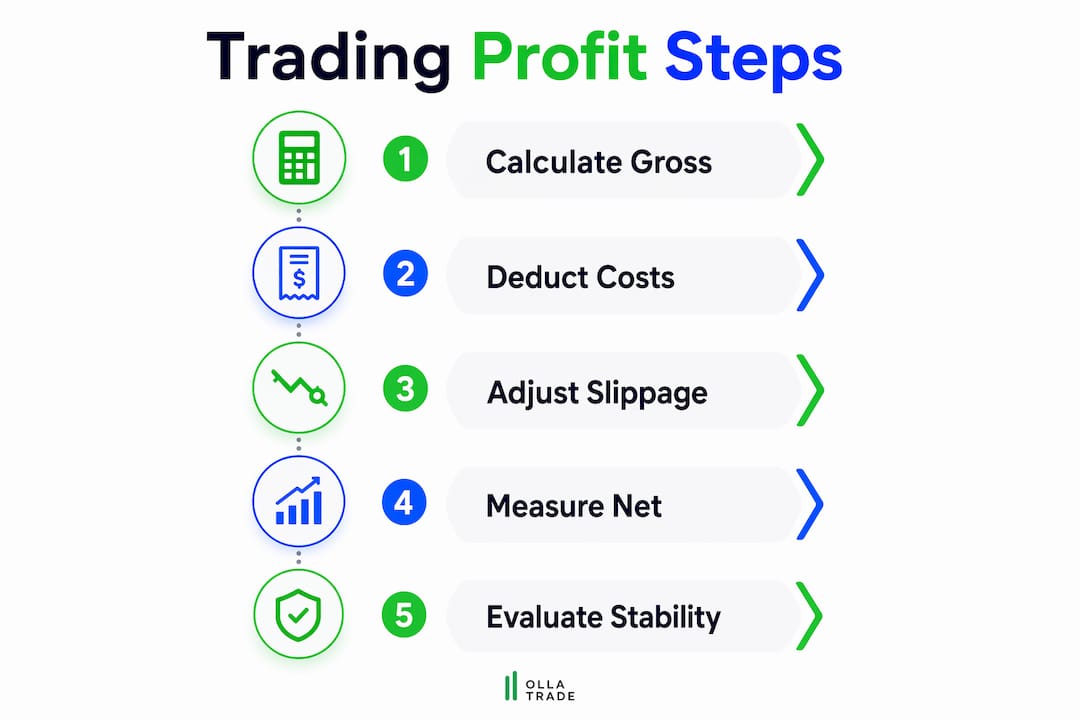
The misconceptions start when traders treat Profit Factor as a report card rather than a diagnostic. As NexusFi analysts note, a high Profit Factor does not tell you about drawdown severity, outlier dependence, or regime sensitivity. A Profit Factor of 2.5 built on 20 trades is mostly noise. The same ratio across 300 trades across multiple market conditions is a genuine signal.
Common measurement mistakes:
- Ignoring transaction costs. Strategies with a backtested Profit Factor of 1.8 often drop to 1.2–1.5 net of real-world commissions, spreads, and slippage.
- Trusting small samples. Fewer than 30 trades produces a Profit Factor dominated by one or two outliers. Aim for 100–200+ trades before drawing conclusions.
- Chasing win rate. A 70% win rate can still produce a losing strategy if losers are three times the size of winners. Profit Factor captures both frequency and magnitude; win rate captures only frequency.
- Curve-fitting in backtests. Profit Factors above 3.0 in backtests almost always signal over-optimization, not genuine edge.
Pro Tip: Always calculate Profit Factor net of commissions and slippage. A gross Profit Factor of 1.8 that collapses to 1.1 after costs is not a solid strategy. It is a fragile one.
darwintIQ analysts reinforce this: a strong, stable Profit Factor across varied market conditions is meaningful. A high number from a short, favorable window reflects the market, not the model.
Strategies that actually increase your trading gains
The most reliable path to higher net returns is not finding a higher-Profit-Factor strategy. It is making your current strategy more durable. Quantified Strategies research shows that trading multiple strategies across different time frames and asset classes improves profit stability more effectively than fixed stop-loss or profit-target levels.
Stop losses and profit targets do not automatically improve results. Adding arbitrary exit levels can degrade performance unless confirmed by rigorous backtesting. A time-based exit, for instance, often reduces drawdown without the optimization trap that fixed targets create.
Practical steps to improve net trading profit:
- Reduce average loss size. Tighter exits on losing trades directly improve Profit Factor without touching your winners.
- Let winning trades run. Cutting profits short is the fastest way to destroy a good Profit Factor. Trail stops rather than setting fixed targets.
- Diversify across strategies and time frames. A portfolio of uncorrelated approaches smooths equity curves and reduces dependence on any single setup.
- Control leverage. Margin amplifies both gains and losses. In futures, a marginal edge at high leverage can turn one bad week into a margin call.
- Keep a trading journal. Logging every trade, including the reasoning and outcome, surfaces patterns that raw P&L statements hide. Platforms with built-in analytics make this far less painful.
Psychological discipline is the variable most traders underestimate. Premature exits, revenge trading after a loss, and abandoning a tested strategy during a drawdown all destroy realized profit even when the underlying edge is intact. Consistent adherence to a defined plan matters more than finding a slightly better entry signal.
For a deeper breakdown of risk management strategies, Ollatrade’s resource library covers position sizing, stop placement, and drawdown control in practical detail.
How the U.S. taxes your trading profits
Short-term trading profits are taxed as ordinary income under the U.S. tax code. That means the same federal rates that apply to your salary apply to every position you close in under one year, per IRS Tax Topic 409. The gap between short-term and long-term capital gains rates is substantial, and for active traders it is one of the largest drags on net annual returns.
Key tax considerations for U.S. traders:
- Short-term vs. long-term rates. Positions held under one year are taxed at ordinary income rates. Positions held over one year qualify for the lower long-term capital gains rate.
- Record-keeping is non-negotiable. Every trade, date, cost basis, and sale price must be documented. Brokers issue Form 1099-B, but the responsibility for accuracy sits with you.
- State taxes vary. Several states, including California and New York, tax trading profits at full state income rates with no preferential treatment for capital gains.
- Trader tax status. Qualifying as a trader in securities under IRS rules can unlock deductions for trading expenses, but the criteria are strict and the rules complex.
Professional tax advice is worth the cost for anyone trading actively. The net capital gain tax treatment differs meaningfully across asset classes and holding periods, and a single misclassification can trigger penalties. Do not rely on generic guidance for your specific situation.
How Ollatrade helps you protect and grow your trading profit
Ollatrade is built around one practical reality: transaction costs and execution quality directly determine net trading profit. Tight spreads and fast execution reduce the friction that erodes Profit Factor on every round trip. For high-frequency traders, that difference compounds across hundreds of trades per month.
The platform’s educational resources address the measurement gaps that hurt most retail traders. Market news, economic calendars, and strategy guides help traders contextualize their performance rather than reacting to raw P&L. Ollatrade supports trading in forex, CFDs on metals, indices, stocks, energies, and cryptocurrencies, covering the asset classes where most active traders build their edge.
For traders who want to avoid the common mistakes that erode profits, including misreading profit metrics and over-leveraging, Ollatrade’s blog and research tools provide direct, practical guidance. The platform is designed for both retail traders building their first consistent strategy and professionals who need institutional-grade execution on a multi-device setup.
How trading profit differs across asset classes
The mechanics of realizing a trading profit vary significantly depending on what you trade. Cost structures, leverage norms, and tax treatment all shift by asset class.
Stocks offer the most straightforward profit realization. You buy shares, sell them at a higher price, and the gain is your trading profit minus commissions. Liquidity is generally high for large-cap names, and the regulatory framework is well-established. Short-term gains are taxed as ordinary income; long-term gains at the preferential rate.
Forex operates around the clock and carries tight spreads on major pairs, but the leverage available, often 50:1 for U.S. retail traders under CFTC rules, means a small adverse move can wipe a position. Net profit in forex is also affected by swap rates on overnight positions, a cost that does not exist in intraday stock trading. Ollatrade’s forex trading guide covers the mechanics in full.
Options introduce complexity that neither stocks nor forex carry. Profit realization depends on the direction of the underlying, time decay (theta), and implied volatility. A trader can be directionally correct and still lose money if the option expires before the move materializes. Tax treatment for options follows specific IRS rules, including Section 1256 contracts for certain index options, which receive a blended 60/40 long-term and short-term treatment.
Futures carry the highest leverage of any mainstream asset class and the most punishing cost structure for marginal strategies. As NexusFi analysts point out, a futures trader running high leverage with a Profit Factor near 1.1 is one bad week from a margin call. Section 1256 treatment applies to regulated futures contracts, meaning 60% of gains are taxed at long-term rates regardless of holding period, which is a meaningful tax advantage over pure short-term stock trading.
Key Takeaways
Net trading profit, calculated after all costs and taxes, is the only number that tells you whether your strategy actually works.
| Point | Details |
|---|---|
| Profit Factor range | Most consistently profitable traders maintain a Profit Factor between 1.3 and 1.8 after accounting for fees and slippage. |
| Sample size matters | Fewer than 30 trades produces unreliable Profit Factor readings; aim for 100–200+ trades. |
| Tax treatment | U.S. short-term trading profits are taxed as ordinary income, not at the lower long-term capital gains rate. |
| Diversify strategies | Trading multiple strategies across time frames improves profit stability more than fixed stop-loss levels. |
| Costs erode edge | Backtested Profit Factors of 1.8 often drop to 1.2–1.5 once real-world transaction costs are included. |
Recommended
Articles are for informational and educational purposes only and do not constitute investment advice. Trading CFDs carries significant risk of loss. Past performance is not a reliable indicator of future results. Olla Trade Ltd. is an Anguilla registered entity.