
What Is Grid Trading? A Practical Strategy Guide
Grid trading is a systematic method of placing buy and sell orders at fixed price intervals above and below a set base price, forming a “grid” of orders across a price range. The strategy profits from natural price oscillations without requiring you to predict which direction the market will move next. Grid trading works best in ranging or sideways markets, where price bounces repeatedly between support and resistance levels. Platforms like MetaTrader 4 make it straightforward to automate the entire order structure, removing the need for constant manual monitoring.
Key elements of any grid trading setup:
- A base price (the central reference point for order placement)
- Fixed grid intervals (the price distance between each order level)
- Buy orders placed below the base price, sell orders placed above
- Take-profit targets set at the next grid level
- A hard stop loss for the entire grid to cap downside if price trends sharply
The strategy carries real risk. If price breaks out of the grid range and keeps trending, losses can accumulate quickly across multiple open positions. Risk controls are not optional.
Table of Contents
- How grid trading works: mechanics and step-by-step example
- What are the main types of grid trading strategies?
- How to set up a grid trading strategy step by step
- Pros and cons of grid trading
- Capital management in grid trading
- Common beginner mistakes around grid spacing and transaction costs
- How does grid trading compare to other trading strategies?
- Which tools and platforms support grid trading effectively?
- Ollatrade gives you the tools to run a grid strategy from day one
- Key Takeaways
How grid trading works: mechanics and step-by-step example
Grid trading profits by placing a series of limit orders at regular intervals, then letting price oscillation do the work. Each time price drops to a buy level, that order fills. Each time price rises to a sell level, that order fills. The difference between adjacent grid levels, minus fees, is your profit per round trip.
Here is a concrete walkthrough using EUR/USD:
- Choose a base price. Assume EUR/USD is trading near a base price and has been ranging within a tight band.
- Set your grid interval. You decide on a fixed interval for grid spacing based on typical market volatility.
- Place buy orders below the base. Buy orders are placed below the base price at set intervals.
- Place sell orders above the base. Sell orders are placed above the base price at set intervals.
- Set take-profit targets. Each buy order has a take profit at the next grid level above it; each sell order targets the next level below.
- Price oscillates. As EUR/USD dips to 1.1030, that buy fills. When price recovers to 1.1040, the take profit triggers and locks in 10 pips.
- The grid rebuilds. After execution, the bot places a new order at that level, ready for the next oscillation.
Grid trading converts natural price oscillation into repeatable profit cycles. It does not rely on directional correctness; it relies on the inevitability of price movement and the certainty that markets breathe.
MetaTrader 4 supports this entire process through Expert Advisors (EAs), which can place, manage, and rebuild grid orders automatically without manual input between trades.

What are the main types of grid trading strategies?
Grid trading types vary by market direction, instrument type, and execution method. Choosing the right variant depends on current market conditions and your risk tolerance.
- Against-the-trend grid (range grid). Buy orders sit below the current price; sell orders sit above. This captures profits when price oscillates sideways. It is the most common setup and works well in consolidating markets.
- With-the-trend grid. Buy orders are placed above the current price as buy stops; sell orders below as sell stops. The goal is to accumulate a growing position as price trends in one direction. This requires a clear exit plan to lock in profits before the trend reverses.
- Spot grid. Orders are settled in cash or the underlying asset. No leverage is required, which limits both upside and downside. Popular in crypto markets where traders want to hold the asset while generating incremental returns.
- Futures grid. Uses leveraged contracts, allowing larger position sizes relative to capital. Profits can be amplified, but so can losses, and liquidation risk is real if price moves sharply against open positions.
- Automated grid (bot-driven). An EA or trading bot handles order placement, management, and rebuilding. Removes emotional decision-making and executes with precision at any hour.
- Manual grid. The trader places and manages each order individually. Practical for learning the mechanics, but demanding to maintain across multiple levels simultaneously.
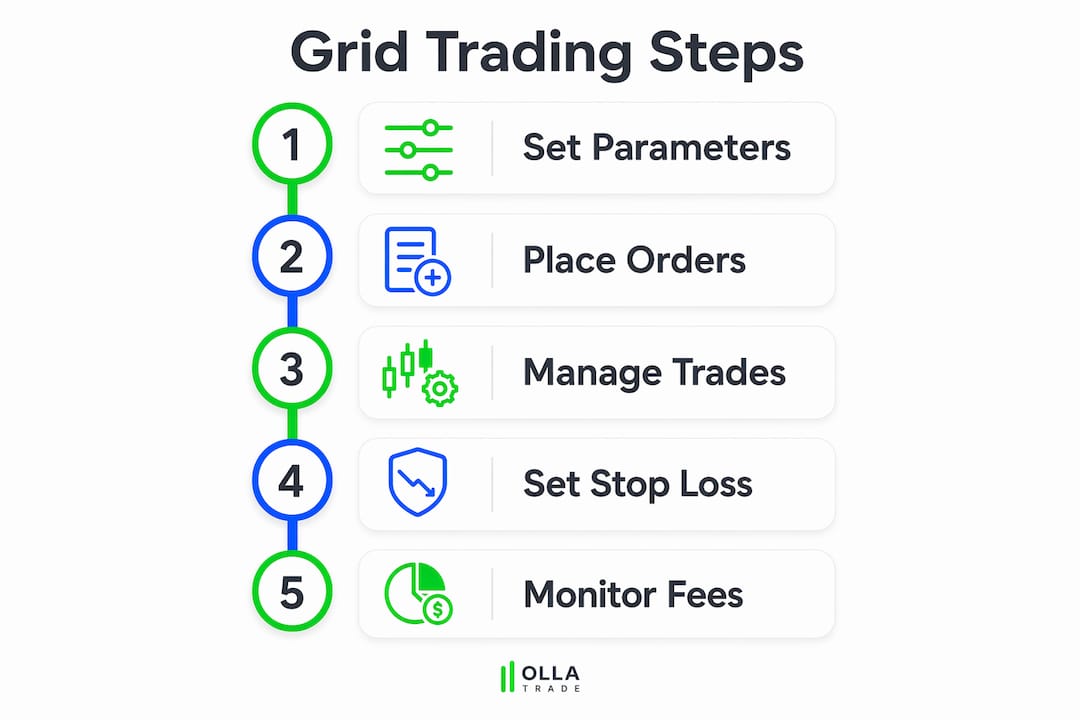
How to set up a grid trading strategy step by step
Proper grid setup starts with recent price history. The upper and lower bounds of your grid should reflect the asset’s actual volatility over a meaningful lookback period, not a guess.
- Define your price range. Review recent highs and lows for the asset. For EUR/USD ranging between 1.1000 and 1.1100 over the past two weeks, those levels become your grid boundaries.
- Choose your grid interval. Divide the total range by the number of levels you want. A 100-pip range with 10 levels gives 10-pip spacing. Tighter spacing means more trades but higher fee exposure.
- Decide on position size. Size each order so that the total capital at risk across all open positions stays within your risk limit. Never size individual orders without accounting for the full grid.
- Set take-profit orders. Each order should have a take profit at the adjacent grid level. This locks in profit automatically as price moves through each level.
- Set a hard stop loss for the entire grid. Place it outside the grid boundaries. If price breaks out and trends beyond your stop, all positions close and losses are capped.
- Configure on MetaTrader 4. Use an EA to automate order placement. Input your grid parameters (upper bound, lower bound, interval, lot size, stop loss) and let the EA manage execution.
- Backtest before going live. Run the setup against historical data to see how it would have performed. Adjust interval and position size based on results.
- Start small on a live account. Use a fraction of your intended capital for the first few weeks. Confirm the grid behaves as expected before scaling up.
Pro Tip: Always set your stop loss before the grid goes live. A grid without a stop loss is not a strategy; it is an open-ended liability.
Pros and cons of grid trading
Grid trading suits specific market conditions well and struggles in others. The table below lays out the trade-offs clearly.
| Advantage | Disadvantage |
|---|---|
| No directional forecasting required | Large losses possible if price trends beyond grid bounds |
| Easily automated via EAs on MetaTrader 4 | Managing many open positions adds complexity |
| Profits from natural price volatility | Transaction fees can erode profits on narrow grids |
| Systematic and rule-based execution | Requires capital reserves to sustain open positions |
| Works across Forex, CFDs, and crypto markets | Stop losses are essential but often neglected by beginners |
The core advantage is that grid trading does not ask you to be right about market direction. As long as price keeps oscillating within your defined range, the system keeps collecting small profits. The core risk is the mirror image of that strength: a market that picks a direction and runs will accumulate losing positions on one side of the grid until the stop loss triggers or capital runs out.
Grid trading is best suited to ranging markets. It is not a fit for assets in strong, sustained trends.
Capital management in grid trading
Capital management determines whether a grid strategy survives long enough to be profitable; reviewing expert tax strategy services can also help traders understand the financial implications of their trading strategies. Poor sizing is the most common reason grids fail, not bad grid geometry.
- Reserve margin for all open positions. At any point, every buy order below the current price may be open simultaneously. Your account must hold enough margin to sustain all of them without a margin call.
- Size positions relative to total capital. A common approach is to divide your available capital by the number of grid levels, then size each order so that the full grid uses no more than a set percentage of your account.
- Apply a portfolio-level stop loss. Individual take-profit orders manage the upside. A single stop loss on the entire grid manages the downside. Proper capital management means setting this stop before the grid launches, not after losses appear.
- Account for transaction fees in your profit targets. Each trade carries a spread and possibly a commission. If your grid interval is 5 pips and the spread is 2 pips, your net profit per trade is 3 pips before commission. Run the math before you set the interval.
- Avoid overleveraging on futures grids. Leverage amplifies both gains and losses. A futures grid with high leverage can hit liquidation before the stop loss even triggers if the price move is fast.
Common beginner mistakes around grid spacing and transaction costs
New traders consistently underestimate how much grid spacing and fees interact. Getting this wrong turns a theoretically profitable setup into a money-losing one.

Narrow grid spacing generates more trades, which sounds good until you count the fees. If each trade earns 3 pips but the spread plus commission costs 2.5 pips, you are netting 0.5 pips per round trip. A single adverse move that triggers your stop loss wipes out dozens of those tiny wins. The math only works when the profit per grid level meaningfully exceeds the cost per trade.
Overly wide spacing creates the opposite problem. Fewer orders trigger, the system sits idle for long stretches, and capital is tied up earning nothing. The goal is a grid interval calibrated to the asset’s typical daily range, not an arbitrary round number.
Fee erosion is especially punishing in crypto markets, where some platforms charge per-trade fees on top of spreads. Always calculate your break-even grid interval before deploying: divide your total cost per trade by the pip value, and set your interval above that number with a meaningful buffer.
Pro Tip: Monitor your trading fees closely across the life of a grid. A strategy that looks profitable in backtesting can underperform live if real spreads are wider than historical data assumed.
A non-negotiable stop loss is the single most important protection against trending breakouts. Without it, a grid that encounters a sustained trend will keep opening positions on the losing side until the account is depleted. Professional traders treat the stop loss as part of the grid structure, not an afterthought. Reviewing top trading mistakes before deploying any grid is time well spent.
How does grid trading compare to other trading strategies?
Grid trading occupies a specific niche. Understanding where it fits relative to other approaches helps you decide when to use it and when to set it aside.
Grid trading vs. trend following. Trend-following strategies buy breakouts and ride directional moves. They perform well in trending markets and poorly in ranges. Grid trading is the inverse: it thrives in ranges and bleeds in trends. The two approaches are almost complementary. Some traders use trend indicators to switch between them depending on current market conditions.
Grid trading vs. scalping. Scalping targets tiny price movements with very short hold times, often seconds to minutes, and relies on fast execution and tight spreads. Grid trading is also targeting small moves, but it does so passively through pre-placed orders rather than active monitoring. Scalping demands constant attention; a grid runs on its own once configured.
Grid trading vs. dollar-cost averaging (DCA). DCA involves buying a fixed amount of an asset at regular time intervals regardless of price. It is a long-term accumulation strategy, not a trading strategy. Grid trading is active and two-directional, capturing both upside and downside oscillations within a range. DCA builds a position; grid trading harvests volatility.
Grid trading vs. martingale strategies. A pure martingale system doubles position size after each loss, betting on a reversal. Grid trading opens both buy and sell orders concurrently within a defined range, which neutralizes overall trend exposure rather than doubling down on one direction. The risk profiles are fundamentally different.
The clearest summary: grid trading is a volatility harvesting tool, not a directional prediction method. Use it when you expect a market to stay range-bound. Switch to a trend-following approach when a clear directional move is underway.
Which tools and platforms support grid trading effectively?
The right platform makes the difference between a grid that runs smoothly and one that requires constant manual intervention.
MetaTrader 4 (MT4) is the most widely used platform for automated grid trading. Its Expert Advisor framework lets you program or install pre-built grid EAs that handle order placement, take-profit management, and grid rebuilding automatically. MT4’s scripting language (MQL4) gives experienced traders full control over grid logic, while pre-built EAs lower the barrier for beginners. The platform also supports backtesting against historical data, which is essential for validating grid parameters before going live.
Beyond MT4, several platform features matter specifically for grid trading:
- Pending order support. The platform must allow limit and stop orders to sit in the market without requiring manual re-entry after each fill.
- Low latency execution. Slippage on order fills eats into the already-thin profit margins of individual grid trades.
- Real-time margin monitoring. With multiple positions open simultaneously, you need clear visibility into current margin usage at all times.
- Tight spreads. Because grid profits per trade are small, spread costs have an outsized impact. A platform with tight spreads on your chosen instrument is not a luxury; it is a requirement.
For crypto-specific grid trading, dedicated bot platforms offer built-in grid functionality without requiring custom programming. These are useful for traders who want to run a spot grid on a crypto pair without writing code, though they typically offer less customization than MT4-based EAs.
Ollatrade gives you the tools to run a grid strategy from day one
Grid trading requires a platform that handles automation reliably, keeps spreads tight, and gives you full control over order parameters. Ollatrade delivers all three through its MetaTrader 4 integration, which supports Expert Advisors, custom grid scripts, and real-time margin tracking across Forex, CFDs, metals, indices, and crypto.
The spreads on Ollatrade’s Forex instruments are structured to keep per-trade costs low, which matters when your grid is collecting profits 10 or 15 pips at a time. Fast execution reduces slippage on grid fills, and the multi-device platform means you can monitor open positions from anywhere. Whether you are running your first against-the-trend range grid or scaling up an automated EA strategy, Ollatrade’s infrastructure handles the load. Open an account and configure your first grid today.
Key Takeaways
Grid trading is a direction-independent strategy that profits from price oscillation by placing buy and sell orders at fixed intervals, with stop losses and fee-aware grid spacing as the two non-negotiable requirements for long-term success.
| Point | Details |
|---|---|
| Core mechanism | Buy orders below and sell orders above a base price capture profits as price oscillates within the grid. |
| Best market conditions | Ranging or sideways markets suit grid trading; strong trends cause losses on the unclosed side of the grid. |
| Grid spacing and fees | Narrow spacing increases trade frequency but raises fee exposure; interval must exceed total cost per trade. |
| Stop loss requirement | A hard stop loss on the entire grid is essential to cap losses when price breaks out and trends persistently. |
| Ollatrade platform | Ollatrade’s MetaTrader 4 integration supports grid EAs, tight spreads, and real-time margin monitoring for Forex and CFD grid strategies. |
Recommended
Articles are for informational and educational purposes only and do not constitute investment advice. Trading CFDs carries significant risk of loss. Past performance is not a reliable indicator of future results. Olla Trade Ltd. is an Anguilla registered entity.